Political philosopher Niccolò Machiavelli wrote some observations on alliances, particularly their problems.
Alliances
Machiavelli, for example in The Prince, chapter 21, observed that political alliances of varying types were fraught with problems.
Strong, mercenary, militant and weak allies doing their typical thing
As a rule of thumb, a stronger partner will use you, mercenaries will sell you out, militants will take you over, and weaker partners can drag you into needless conflict.
Military alliances do not prevent wars: they may accelerate the march to war, extend war's theatres, increase war's damages, prolong the war, and sometimes give the most vindictive allies the final say in the following peace (piling up new problems). Allies may end up becoming subjects of empire run by a power they once considered a partner (as in the Athenian Empire which grew out of the Delian League).
In war, or other kinds of conflict, it is not only the result (which can sometimes be ambiguous or contested) but the whole conduct of the conflict that can vary the outcomes on alliances. Allies are often written out of nationalistic histories, or downplayed, or even turned into villains.
Common Causes
However, common causes are different, and may not even need formal alliances. Although just because you have a common cause doesn't mean that you will fight side by side. When the Persian Empire began invading Greece, the Greek cities had common cause to resist, but only a relatively few city states committed to armed resistance.
It is likely that states will find common causes with most enemies too, which is generally how wars end without total annihilation.
Might William Shakespeare's play The Comedy of Errors be essentially a multiverse story, arguing against predeterminism, and for human agency (to some extent)?
Introduction
The plot of Comedy of Errors features an unlikely pair of identical twins, separated by an accident at sea. My argument is that this accident constitutes a Sliding Doors moment, which is what the play is really concerned with, despite appearances.
This is not the fan-fiction/multiple interpretations take on Shakespearean drama. Rather we see in one tale how the lives of two people (joined by a master and servant relationship) could play out in two different (yet somewhat similar) ways.
This approach begs the question of whether other plays in Shakespeare's ouevre have similar encoded divergences. And does this happen elsewhere in literature? I would argue that folktale siblings sometimes represent divergent paths that a single person could take. You could view it as the serialisation of a decision tree, where multiple outcomes of choice or random events are simultaneously presented.
Antipholus and Dromio of Syracuse | Antipholus and Dromio of Ephesus
But why would Shakespeare be interested in presenting a multiverse model? I have some ideas, but first, the Play.
The Play
After the shipwreck (recounted by Aegeon), one set of the Antipholus and Dromio infant twins go with him to Syracuse (I'll refer to them as Ant/Syr and Dro/Syr), the other with Aemilia to Ephesus where the action takes place (Ant/Eph and Dro/Eph, I'll highlight the home team). Right at the start, Aegeon describes:
two goodly sons,
And, which was strange, the one so like the other
As could not be distinguished but by names
Confusion
But each son is given the same name, Antipholus. And the pattern repeats for the sons' servants, both identical, both called Dromio. You could argue the play would not 'work' otherwise, requiring this for mistaken identity, but why write such an improbable tale in the first place? Furthermore, at least one set of twins is seeking the other, which Ant/Syr confirms on arriving for the day's events in Ephesus.
Fatal Attraction
In another Shakespeare play, the character Ford comes to the conclusion:
In love the heavens themselves do guide the state.
Money buys lands, and wives are sold by fate.
However, attraction seems variable for the twins, the Antipholuses towards different sisters, the Dromios towards and away from kitchen maid Dowsabel.
Status Effects
Ant/Eph is joined to his wife Adriana after wartime service to the Duke of Ephesus, and gains elevated status from this. Ant/Eph has put down roots and appears outwardly to be thriving and is reportedly well-liked and trusted, yet Adriana has noted her husband to be heavy, sour, sad in the past week before the arrival of itinerant twin Ant/Syr upsets his ordered life.
Systematic Beatings
However, both twin masters beat their twin servants. This could be Shakespeare saying this is structural form of behaviour, borne out of the master–servant relationship, with its inbuilt power imbalance. The servant-beating is normalised, though never accepted by the Dromios who persistently complain, and Ephesus society apparently frowns on excessive public abuses. There is a seed of dissent here.
Dividing and rejoining paths
Of course, some differences may be temporary. Ant/Syr is a bachelor, but marriage is only delayed not deferred.
Mirror, Mirror
Mirrors (or as Shakespeare sometimes calls them, glasses) play significant parts in some multiverse stories, as physically-crossable portals, or as transmitters of information (or both). They can also represent self-knowledge, or vanity. What would we do if we could see alternate paths, alternate futures? What personal growth (or otherwise) do the Dromio's exhibit on seeing their mirror counterparts? Would the Antipholuses continue to beat the Dromios so enthusiastically if they could, as it were, see their own behaviour from outside?
The Point
Agency
At a basic level, Shakespeare shares the general dramatist interest in human agency, questions of chance, circumstance, personal history and fate.
Fate
But on another level, Shakespeare plays with the repudiation of Christian predestination, sometimes associated with protagonists like Hamlet, sometimes with antagonists like Edmund, other times with comedic characters (as in Benedick's predestinate scratched face mock).
Shakespeare seems interested in what we can change about our human condition. There is very little sense that heredity plays an important role shaping Shakespeare's characters. As even heiress-to-a-dukedom Miranda says, Good wombs have borne bad sons..
Society and structure have a hold (hence the servant-beating, which features in other plays). Education and experience combines with innate qualities (the age-old Nature–Nurture debate). Shakespeare is also clear we are not tabula rasa (blank slates) either.
Other Plays with Doubles
Macbeth and Banquo are an interesting pair. They encounter prophecy together, but take different paths, although their circumstances are not identical.
Edmund and Edgar (see also Bastard and Faulconbridge) represent pairs of step-brothers where one is deemed illegitimate, a status which acts as a driving force for plotting, though Nature presumably doesn't care either way.
Viola and Sebastian are another pair which are closer to the multiversal Sliding Doors moment, though they are different sexes, yet are mistaken for each other.
Sebastian and Antonio in the Tempest are differentiated by one deposing a brother while the other is stopped in the act, which presents an interesting question about their different capacities for regret.
Trouble with Triples
The folktale sibling pattern of youngest-wisest-kindest-sibling-of-three is not evident in the three sons of Richard of York, which is rather a reflection on the sibling rivalry proximate to the throne.
Possibly the closest match is Cordelia as youngest of three daughters of King Lear, but none of these dynastic dynamics is really a fair comparison, there's just too much interaction (and competition) between the siblings.
Conclusion
In the Comedy of Errors, moreso than in the other surviving plays, Shakespeare seems to be exploring the multiverse in terms of how one character (or rather a pair of characters) might take different paths in alternate universes, even though it is presented as a pair of identical twins seeking and comically finding another in just one universe.
Shakespeare is interested in similarities and differences, and what may cause these. Nature versus Nurture, ideas of Christian predestination or 'there but for the grace of God go I', human agency, slight starting variations leading to larger divergences down the line (as in complexity theory's butterfly effect), as well as convergences (from structural, society or predisposition causes, for example).
Consider this was a comedy, with a happy ending, multiple marriages in the offing, no great bloodshed, family reunion, etc. How might Shakespeare have treated the topic in a tragedy? When a tragedy could be (especially if easily) avoided, the drama can become a cautionary tale. Learn to swim, young man!. Perhaps in some respects Shakespeare's plays were the public information warnings of their day. But that's a subject for another post.
One of democracy's fatal flaws is its exploitation in population growth, depopulation and disenfranchisement.
Introduction
As a corollary of our thought experiment on the Sea-People’s Citizen Assembly Scenario, we consider how democracy foments population growth races (or depopulation, or disenfranchisement). See for example Northern Ireland, Israel, total war, genocide, ethnic cleansing, settler colonialism, Jim Crow, nativism, denial of votes for women.
The outcome of Population Races hangs in the balance
In many cases, there is an assumption that people from certain demographics will vote in a predictably derivative way. Many political parties are set up to represent an interest group, or at least claim to be doing so. This could be a religion, a working class, a racist/nativist group, a pensioners party, a party of (aspirational or overt) riches, and so on. Or a geographical distinction, perhaps with a separatist goal.
By manipulating demographics, if other means like gerrymandering aren't enough, an electoral majority or at least plurality of seats may be sufficient to gain power for a party that represents a segment of the electorate. This could mean a long-term strategy of high birth rates, or disenfranchising opponents, or making use of concentrations or dilutions of population, or moving demographic groups in or out of areas. In the past, various requisites (like property-owning requirements, sex, age, ancestry, literacy tests and so on) have been used to manufacture an electorate, deny citizenship, or deny voters at polling booths.
At the more extreme end, this could mean settler colonialism, ethnic cleansing, forced sterilisation, culturecide, ecocide and genocide. All of which have been done in so-called democracies.
Conclusion
Yet another essential flaw in democracy, a political system which can be expressed through contesting populations. This is not a flaw of biocracy, a political system which is fundamentally concerned with how populations can coexist peacefully and fruitfully.
That is, there are no 'Good Guys' as any class, faction, faith, ideology, nation etc.
Introduction
It may be very difficult to build popular support for a movement or party without flattering at least one set of people. And to create contrast, the flipside is often demonising, patronising or ignoring Others.
There are no 'Good Guys'
Valorisation and Heroisation
Political parties, movements, factions, religions, activist groups are typically (and perhaps nearly always) partisan in character.
Nationalists spin myths of their compatriots' glorious past. Right-wing populists imagine their 'pure people'. Religions for the divinely chosen, favoured or rewarded. Class war activists proclaim the virtues of the working class, or on the other side the ruling class. Erotic alliances paint their membership in pretty colours or whitewash. New subcultures emerge with their own positive spins, grievances, othering and supremacy cults. Old established cultures like European imperialists perform primitive ancestor worship, whether direct descendants or not, and their racism reverberates around the world.
Such classes are thus valorised: bigged-up as a group, leading to well-known in-group and out-group tendencies. Mythical pasts are favoured over accurate histories. And individuals from these groups are selected for heroisation: hagiographies rather than warts-and-all portraits. Narratives about victims, martyrs, convenient villains, glorious struggles, national or endemic characteristics are created and pushed.
The Biocratic Alternative
The point of good examples is to abstract from, not idolize.
Biocracy rejects theist and humanist hierarchies in Nature. Humans have learnt to live poisonously on Earth. Therefore humans should learn from other lifeforms how to govern better. These lessons learnt, humans can contribute positively to living planet self-government.
So other hierarchical categories, such as favoured animal 'good guys', 'vermin', 'weeds' and so much be rethought, rejected. We can still keep distinctions between invasive species and aliens which disrupt and degrade ecosystems, often carried by human agency or carelessness. Unhealthy monocultures are the result of human favoritism too.
The aim of biocratic governance, as we have described elsewhere, is the promotion and maintenance of Health at every level. And this does mean defending humans, other lifeforms, their environment and planetary systems from 'Bad Guys' (without justifying collective punishment). It is reasonable to prioritise defence against ecocide and work down from there.
Conclusion
The democratic partisan is reduced to slandering opponents and defending the indefensible, flattering a powerbase with word-bribes and ego-stroking.
The biocratic planet-defender transcends poisonous partisanship and rejects the idea of 'good guys', favouring clear-sighted self-reflection and universalist sciences wherever these come from, in the service of (planetary) life.
This is not an argument that Life has any intrinsic or sacred value. Instead it is an argument that creating value is a function of life.
Life generates value
Thought Experiment
Imagine a barren world on the other side of the Universe where humans will never set foot. Now imagine that simple life appears here for the first time. It requires food: a new value is applied to some material subset of the world. Other values appear as life develops, evolves, complexity and variation increase. As life, and the behaviour of living organisms emerges, so do values.
Implications
As an organism grows, its range of values are likely to grow (up to a point, maybe), and even change over its lifetime, and through its encounters and experiences. The values of a hunting predator are likely to be characteristically different from that of a grazing herbivore, say; of a social animal compared with a solitary lifeform.
But the point is that value emerges from life, not as a theoretical or imposed perspective, but organically and instrinsically, as a natural process.
Conclusion
Life, itself an emergent phenomena, generates value, as an emergent property or behaviour. These values may be simple or complex, stable or unstable, specific or experiential. One could even define life as a value-generating phenomena, although I suspect this would be a problematic reach. As would claiming only life generates value. But as an observation, I think accurate enough.
One of democracy's fatal flaws is its reducibility to a battle of wills.
Introduction
Following our reflections on our thought experiment on the Sea-People’s Citizen Assembly Scenario, we see that democracy pits people against each other in a contest of wills. It does not consider Health at any scale. This leads to Militarism (War as a continuation of politics, not a break from it).
The outcome of Will over Health
Conclusion
Another essential flaw in democracy, that as a political system it elevates the expressed views (or will) of humans, or a subgroup of humans, over all other requirements for living together, ignoring Health. This is not a flaw of biocracy, a political system which prioritises Health.
Philosopher Peter Singer, who specialises in subjects like animal ethics, writes in Animal Liberation Now (2023 version) pp4–5:
Speciesism, in its primary and most important form, is a prejudice or bias in favor of the interests of members of one’s own species and against those of members of other species, on the basis of species alone.
Secondary speciesism occurs when, for example, humans favour dogs over pigs.
Singer believes that speciesism (a type of bigotry), is inculcated into small children in Western society (otherwise p245 Children have a natural love of animals), partly to encourage them to consume meat knowing that it is animal flesh.
Conclusion
These undesirable (and unjust) ends are due to an essential flaw in democracy, that as a political system it only takes account of the expressed views (or will) of humans, or a subgroup of humans. This is not a flaw of biocracy, a political system which opposes the speciesist orientation.
A thought experiment to test democracy in a non-human scenario.
Introduction
Popular fiction often depicts sea-people as ruled by monarchs (Disney, Marvel, DC Comics) but suppose that our fictional sea-people have the very best form of democracy you can imagine. This could involve citizen assemblies, mandatable recallable delegates, anything you consider to be best practice.
The Sea-People's Citizen Assembly, diversity champions, hard at work
Now imagine a scenario whereby, perhaps in retaliation to land-people dumping waste in the sea, the global sea-people community democratically decide to dump some of their waste on land. This leads to friction, leads to war, all with ideal democratic processes followed perfectly by our sea-people, leads to annihilation of land-people civilization and many living species by weapons of mass destruction.
If you consider this a bad outcome, from an ideal form of democracy, what is wrong in this scenario? Is the problem the extension of democracy to non-humans, even if they are in many ways very similar to us? Or are there any flaws in democracy you can identify?
Four special editions of BBC's Doctor Who primetime 'Adventures in Time and Space Drama' broadcast in 2023 exhibit far-right tropes, so what are these, and why?
Introduction
First we will set the scene regarding the direction the rebooted Doctor Who has been moving in.
Then we will take each of the Specials in turn to pick out specific and common tropes, include some feedback from right-wing press reviewers, present our conclusions and speculate as to motives.
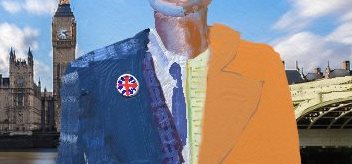
"Doctor Whos, defenders of London, home of the BBC, the Centre of the Universe"
And yes, of necessity there will be spoilers. Before we start, a brief note.
Art develops at scale
Or: more patterns emerge as a body of work grows. Stereotypes or typical traits emerge more clearly over a body of work. Silences, avoidances, distortions, favourites are easier to spot when the opus of a creator (or a country's creative industry) is considered, than in a single work. The forest emerges from the trees. So, we consider that the repetition of consistent themes in four Specials is a much more significant pattern than themes in one or two out of four.
The Direction of Travel
We have already analysed the Doctor Who reboot up until the The Return of Doctor Mysterio (2016), which provides us with some starting themes.
Londocentrism
Instead of the BBC's own pitch of Adventures in Time and Space, we get larks in London and Cardiff (and Sheffield).
Individual-Over-the-Collective
Since the reboot, Modern Who embodies the rightwing Great Man (Occasionally Woman) View of History (reminiscent of the BBC's own star system?) while Classic Who typically tried to avoid it (the Classic Doctor started off as a researcher with a malfunctioning TARDIS, and was not the locus of problem-solving). However, even more extreme valuation of select individuals have arrived with the trend towards ego-dominance politics of Modern Who.
Appearances
There is a highly regressive feel about Modern Who's preoccupation with superficiality and the perceived outward attractiveness of characters, which leans towards speciesism and a narrowing of focus.
Monsters and Terrorists
Aliens are now typically monsters or terrorists, to be defeated or killed, preferably both.
No Such Thing as Society
In all the broadcast reboot, there is no alien society fairly sketched.
Child endangerment
Red flags, combined with the celebrity-importing and sexualised themes and styles.
claiming that the decision to allow people claiming refugee status to enter the United States would "come back to bite us", as happened to the woman who took in the snake in the song.
Now, appearances-can-be-deceptive is by itself a useful instruction, albeit one the appearance-obsessed Modern Who applies selectively. But because of the show's current Anglocentrism, aliens are mostly shown as visitors, and here an actual asylum-seeker, the Meep, who turns out to be a mass-murdering fugitive from justice.
Donna: “I would burn down the world for you” (09:39). Well, the Doctor previously would have destroyed the Universe for Clara, so perhaps this counts as progress. As in the small-minded focus on Donna’s ‘terrible price’ (she forgets the Doctor and adventures), the rightwing Self-Over-the-Collective trope manifests in various ways throughout these specials.
I was left wondering if a BBC drama about London firefighters tried to make the main characters sympathetic by having them dither over whether to tackle a city-threatening blaze or nip round to see if their own house was OK, what the viewer reaction might be. Nobody seemed all that fussed about some distant civilization or galactic council being obliterated or eaten, and even the Doctor's apology expression of regret for getting the bumbling galactic cops murdered by an entity in his own custody seemed merely for form.
Wild Blue Yonder
Wild Blue Yonder is a war song, but a USAmerican not a British one. Why the distancing?
The aliens use terror to make copying easier. Replacement is one of the far-right’s concerns, but perhaps that is just a coincidence here, and is more like Capgras syndrome, or just identity theft.
No alien/foreign society yet again. Instead a laserlike small-minded focus on characters, yet again, as with celebritising history, here fun-washing the reputation of Isaac Newton, who blew his fortune investing in slavery during the South Sea Bubble, which might have been worth a look (Modern Who similarly fun-washed the reputation of public racist Charles Dickens in a cringeworthy fanboy episode).
The Giggle
John Logie-Baird has a important historical role as a television pioneer, as do many (see Wikipedia), and his mechanical system is not the forerunner of modern electronic screens (that would be a right-wing British-invented-television myth) which the episode requires.
The concept of television is the work of many individuals in the late 19th and early 20th centuries.
The unexplained Vlinx (robot, alien, alien-robot?) is the real hero for inventing the Zeedex inhibitor. The Doctor seems to think the Vlinx has an organic brain, since he asks if it is affected by the Giggle-Signal.
The Doctor acts as World Dictator (see 16:22) in authorising the strike against the South Korean satellite. Later (from 38:01) the Doctor peremptorially treats the Vlinx as a servant, slave even. Even it was a robot, so was K9, and the Doctor didn't treat it as a slave. So maybe more of the Modern Doctor's racism/speciesism/bigotry.
The Toymaker’s cod-Euro accents and obsession with rules marks is unmistakably a caricature of European Union bureaucracy, therefore this villain seems designed to please right-wing Brexiteers.
Donna’s lack of empathy for the bereaved Stookie family is characteristic but her violence seems particularly disproportionate to their limited threat, killing the children in front of their mother, who seemed to be a sentient lifeform, presumably capable of at least psychological pain (grief).
At least this episode had the potential to say something interesting about society, but it never materialised, along with other missed opportunities (like to say something interesting about gaming, often a bugbear with the right, despite its own right-wing cadres).
The Church on Ruby Road
One might suppose that JK Rowling's troubles with goblins might have been a lesson worth learning, but here Modern Who goes further, evoking gypsy curses, child abduction, possibly even blood libel territory. A traveller community living among us; a wainscot society whose discovery might be expected to be joyous, even if there are initial conflicts; but no, they must be mass-murdered by way of a Christian church steeple, which suggests they are infidels, pagans, non-Christians or just not High Church enough. Well, it wouldn't be the first time the Doctor was hauled before a court on a genocide charge.
In reality, it is organised religion and particularly hierarchical high churches that pose especial risk to children, something that, as another hierarchical organisation with form, the BBC should be all too aware of. But look, over there! Travelling folk! I mean, Goblins! This follows a standard right-wing pattern of denying actual abuse at home while projecting blame on others (or Others).
Petty human concerns and self-absorption fill this episode, when real humans might have other things on their mind than partying; this is a continual problem in setting Doctor Who in present-day Britain, it must to some extent ignore current affairs and make its characters appear more ignorant as a result.
Another urban setting. No (non-humanoid) animals? It’s actually quite difficult to find a children’s/family Christmas special that doesn’t have animals (often as subjects in their own right), so what’s going on here? The fate of non-human life on Earth is not an apparent concern. Nothing to gladden the heart of an environmentalist or brighten the eye of a budding biologist. Strangely for a Christmas special aimed at children, it is very much Nature-avoidant, and the only tree appears in drag, toppling towards Davina McCall.
Reviews in the right-wing press
If Doctor Who is now supposedly woke, why doesn't it cover the same issues as Al Murray's Why Does Everyone Hate the British Empire? That these areas are off-limits must be very pleasing to the reviewers in newspapers like the Daily Mail and the Daily Telegraph. Here are a small but representative selection of their views.
Doctor Who review: Power-crazed aliens, cosmic cops... this show is back to its best,
writes ROLAND WHITE for the Daily Mail ***** (five stars) for The Star Beast
Doctor Who: Wild Blue Yonder, review: a jaw-dropping injection of sheer Saturday night magic
***** (five stars, Telegraph)
Doctor Who: The Giggle, review: David Tennant hands over to Ncuti Gatwa in unprecedented regeneration
**** (four stars, Telegraph)
Doctor Who review: All-swinging, all-dancing, this athletic new five-star Doctor has thankfully left the weary, wokey preaching behind, says Christopher Stevens for the Daily Mail, for The Church on Ruby Road
Further Reflections
Ditzy, clumsy, error-prone, delulu or snarky women
From Donna spilling coffee into the TARDIS console to the succession of clumsy/incompetent women in the Christmas special, Doctor Who seems to have a problem with female characters. The somewhat clunky statement of female competence in the Giggle seems like a conscious attempt at bias correction. So while there were organic misogynistic tropes in the Specials, there were also signs of mechanical editorial correction.
Speciesism
It is pretty clear that Modern Who is especially antagonistic to non-human life, which is curious considering that many science fiction and fantasy shows make use of computer-generated graphics to give life to them, often joyously or poignantly so. But here there is an obvious hierarchy within humankind, with the current population of London being close to the top, while further off in space and time humans dwindle into comparative insignificance, though may at least be occasionally visible/mentioned.
Conclusions
Mere dislike of foreigners would be right-wing, but to repeatedly cast them as terrorists, mass-murderers, vaudeville artistes and baby-eaters and joy in their defeats and destruction pushes the dial firmly to the far-right. This brief analysis has uncovered other patterns of right-wing tropes, also reflecting strict and stable worldview hierarchies. Furthermore, ego-dominance ideologies, the self over the collective, are another repeated pattern.
Additionally, it is the silences, avoidances and exclusions that really seem to be welcomed by the right-wing press. With a fully-functional TARDIS, the Doctor could take companions on research trips through the history of the British Empire (and the rest of topics of interest to the likes of Horrible Histories) so the Modern Who idea of a party-taxi TARDIS seems almost obscene by comparison. Even the fantasy elements of Modern Who seem designed to poison the well of history (although to be fair, Classic Who and Transitional Who also produced their uncomfortable this-changes-everything storylines).
Is the BBC trying to placate a wing of the ruling Conservative Party and its right-wing newspaper backers to protect its licence fee? Is this a trade-off so it can also broadcast more Establishment-critical shows (like Vigil)? Is there an element of elitism, Londocentrism and institutional racism in the BBC management? Or is it a case of the personal tastes and biases of a small clique of creatives? Is there a particular kind of groupthink within the BBC given its documented demographic overrepresentations? Who knows.
An investigation into the themes behind Shakespearean dramatic characters who move to save blood (other than their own, or close kin) from being shed, or lives being lost, typically in mass suffering or injury or killings.
Introduction
In Shakespeare's plays, there are characters who sometimes intervene, or plan, to prevent bloodshed on a significant scale. The characters of interest here are generally neither peacemakers per se, nor pacifists; and generally ones who go beyond purely partisan interests.
And will, to save the blood on either side,
Try fortune with him in a single fight.
The more realistic plays offer more general insight, so The Tempest's magic-wielding Prospero (who forsakes bloody revenge) is not included. Neither here considered are As You Like It's Rosalind (who creates a kind of marital peace, but the blood feuds are settled off-stage), nor The Merchant of Venice's Portia (only a single character's blood is saved, and Portia’s victory lacks justice, fairness and mercy). Neither considered are Troilus and Cressida's Hector advocating returning Helen and sparing defeated foes (a possible yet partisan fit), nor Romeo and Juliet's Prince, Nurse, Friar and Romeo himself, all of who have some shout in bloodsaving, yet whose motives appear counterweighted, compromised or opaque. Nor will characters who appear to have consistent pacifist or bloodshed-averse views be considered here (like Virgilia in Coriolanus). These tend to be untested characters (pacifism is awkward to be absolute in).
Verona's civil broils and Milan's coup are significant here, however, in broaching Shakespeare's concerns with civil war and conflict within kin groups.
To illustrate this theme, the following characters will be examined: Edmund of Langley Duke of York (Richard II); Hamlet, Prince of Denmark (Hamlet); Titus Andronicus; and Pericles. I will also explain why a few characters (like Prince Henry in the quote above) cannot reasonably be counted as bloodsavers.
"Draw not thy sword"
Pericles: perilous playboy or humanitarian hero?
Pericles, Prince of Tyre is a play concerned with good and bad government. Pericles endangers his own population by recklessly seeking the daughter of powerful Antiochus as a bride.
When all, for mine, if I may call offence,
Must feel war's blow, who spares not innocence:
But in recompense, almost immediately relieves famine in Tharsus with purpose-brought grain, for which he largely wants only friendly relations and use of a port.
Pericles' attitudes to his subjects and subordinates is ambiguous. In A2s1, fishermen pity Pericles’ lost crew whose fate he seems oblivious to, though he may be half-dead with cold. While in A3s1, Pericles agrees to appease sailors’ superstitions and tosses his apparently dead queen overboard to save lives, though a fear of mutiny is also a likely motivation.
Another candidate bloodsaver in the play by vocation and practice is lordly physician Cerimon, who seems to attract honest admiration for good works (and a good work ethic).
I held it ever,
Virtue and cunning were endowments greater,
    Than nobleness and riches”
Pericles fears the bloodbath that could be visited on his subjects/countryfolk (by Antiochus) and takes indirect means to avoid it. Yet later, under oath to goddess Diana says he was frighted from his country. Frighted for himself, his subjects, or both?
Hamlet: Denmark in Danger
Hamlet is Shakespeare's great play about Communication. Intriguingly, for all of Prince Hamlet's soliloquies, we still have to guess about a great deal of his motivation. From early in the play, we learn of enemies without and divisions within Denmark. A sizable number of Danes appear happy that usurper-King Claudius is hosting drunken revels rather than making them go off and wage war against formidable foes in the cold shores of the Baltic. Under Hamlet's cloak of madness, he may be settling scores (Polonius) or trying to repel/entreat others to a place of safety (Ophelia).
The play's foreshadowings are a much more reliable guide to its ending than Hamlet's musings. For example, in A2s2 the player’s speech features the destruction of Troy in flames and blood. In A3s1 Claudius smells danger.
But in case you missed all this, it is spelt out by a minor character:
The cease of majesty
Does not alone; but, like a gulf, doth draw
What’s near it, with it: it is a massy wheel,
Fix’d on the summit of the highest mount,
To whose huge spokes ten thousand lesser things
Are mortis’d and adjoin’d; which, when it falls,
Each small annexment, petty consequence,
Attends the boist’rous ruin. Never alone
Did the king sigh, but with a general groan.
Hamlet learns that thousands may die battling over a patch of land:
I see
The imminent death of twenty thousand men,
By A4s5, Queen Gertrude fears some great amiss and King Claudius fears the resentful people led by Laertes, drawn home by father’s death, as if people should choose their own king. On the other hand, in A5s2 Hamlet relates with relish how he sealed the fate of Rosencrantz and Guildenstern, and pleads diminished responsibility to Laertes.
On the balance of probabilities within the text of the play, Hamlet forsees how enacting his revenge against Claudius will lead to bloodshed. On this reading, Hamlet's struggle to hold a King to justice can be read as an attempt to take the least bloody path, the means by which Gertrude, Ophelia, Laertes and others deemed not guilty will be spared (interestingly, Hamlet seems to regard Horatio as both valuable and expendable, ironically as it transpires). Shakespeare turns our attention to systems, to question why the rule of law does not apply for regal power with royal prerogative, to effectively propose election. But… do we really believe Hamlet's protestations that he does not value his own life? And how much does Hamlet really value other lives?
Henry V: premeditated war criminal
See above quote when Henry was a Prince. In Henry V A1s1, Henry protests his care not to shed blood, but it is clearly a pretence. See his father’s advice in the previous play. We later see his manipulation of traitors and mercy. Henry’s threat to French king, and particular to Harfleur, are chilling, horrifying, indeed terrorism. While soldiers before battle tell it like it is. Henry V is not a bloodsaver, though we see him pose as one when it suits.
Titus Andronicus: oops
It might seem strange to view Titus, a blood-shedding 40-year warrior for Imperial Rome, a sacrificer of a prisoner and murderer of his own son on his return, as a bloodsaver, but consider this. The homecoming warrior is both weary of blood and power but not honour “Give me a staff of honour for mine age” (A1s1), arrives unprepared for Roman politics at a wave of civil strife which immediately threatens to settle succession by open civil war. Titus (why does Rome keep repeating the mistake of electing victorious generals in Shakespeare’s plays?) is patently unsuited for civil office, unlike his diplomatic brother Marcus, and foists the even less suitable prince Saturninus on Rome, in apparent attempt to save blood on the streets.
This shows the sometimes disastrous side of blood-saving when it fails to treat the underlying problems or address politics maturely and responsibly. The younger princely brother Bassianus, already engaged to Titus’ daughter Lavinia, was the safer choice of Emperor, but whether through haste, respect for primogeniture or another reason, Titus makes this bad choice which sets the rest of the play on a tragic course. If Saturninus failed to accept Bassianus’ ascent, then likely the combined supporters of Titus, Marcus and Bassianus would have decisively prevailed in the civil conflict without weakening Rome as much as electing Saturninus does.
Undoubtedly Titus' character changes over the course of the play, distracted by grief and horror if not true repentance. When Marcus kills a fly, Titus is enraged by this tyranny over the innocent (and may not that fly have a mother and a father?), until Marcus denies the fly’s innocence. Perhaps there is a sense of Titus, so long the enforcer of Rome's 'Might is Right' imperial policing, failing to empathise with the innocent until the atrocity inflicted upon his daughter Lavinia finally (and far too late) opens his eyes, even to the point that flies might have rights.
Edmund of Langley Duke of York: the honourable exception?
When Shakespeare's dramatic projects want to stress an attribute common in a class of people, the playwright typically inserts an exception somewhere to emphasize what is the norm. Therefore Cressida is unfaithful, even though female characters are normally faithful. Prolix characters are generally politically inept, yet Gonzalo is astute. This is a powerful way of challenging stereotypes and emphasising the individual agency of characters, but also of judging social classes (the odd good king does not detract from Shakespeare's devastating critique of hereditary monarchy).
Most peace-making attempts fail in histories and tragedies (Edmund York may be an exception, but only a postponement). So we come to Richard II, and another looming civil war.
A number of characters, including the principal contenders for the throne, King Richard II and his cousin Henry (Hereford/Lancaster) Bolingbroke, make protestations about how they deeply care to spare the blood of subjects. Some notable quotes on this theme:
And for our eyes do hate the dire aspect
Of civil wounds plough’d up with neighbours’ swords
Why have they dar’d to march
So many miles upon her peaceful bosom;
Frighting her pale-fac’d villages with war,
And ostentation of despised arms?
It is noticeable that really only York uses humour in the play to defuse tension and (interspersed with more assertive passages) attempts to appear both relatively harmless and yet just.
If not, I’ll use the advantage of my power,
And lay the summer’s dust with showers of blood,
Rais’d from the wounds of slaughter’d Englishmen:
The which, how far off from the mind of Bolingbroke
It is, such crimson tempest should bedrench
The fair green lap of King Richard’s land,
My stooping duty tenderly shall show.
But Richard and Henry are quite happy to make such threats:
Armies of pestilence; and they shall strike
Your children yet unborn, and unbegot…
The purple testament of bleeding war;
But ere the crown he looks for live in peace,
Ten thousand bloody crowns of mothers’ sons
Shall ill become the flower of England’s face;
Change the complexion of her maid-pale peace
To scarlet indignation, and bedew
Her pastures’ grass with faithful English blood.
So no offer of single combat, then. A contrast is immediately provided by the gardeners (A3s4) who espouse a kind of biocracy, a view that a nation should be tended for all that live in it.
Richard II is the play which begins an arc of plays covering a bloody period in English, Irish, Scottish, Welsh and French history, a time of invasions, dynastic conflicts, political murder, civil war, massacres, various other war crimes and unnecessary infliction of mass suffering. We are given a foreshadowing of these future events:
And if you crown him, let me prophesy,—
The blood of English shall manure the ground,
And future ages groan for this foul act;
Peace shall go sleep with Turks and infidels,
And, in this seat of peace, tumultuous wars
Shall kin with kin, and kind with kind confound;
Disorder, horror, fear, and mutiny
Shall here inhabit, and this land be call’d
The field of Golgotha, and dead men’s sculls.
O, if you rear this house against this house,
It will the wofullest division prove,
That ever fell upon this cursed earth
These likely effects are obvious enough to Carlisle, and indeed to York, who in striving to prevent them (for example, by remaining neutral in A2s3), perhaps only postpones them.
In the closing Act of the play, York privately states his allegiances to his wife, although the subtext is loyalty to the enduring state, rather than whoever currently sits on the throne:
To Bolingbroke are we sworn subjects now,
Whose state and honour I for aye allow.
and immediately has cause to demonstrate such allegiance. On discovering their son Aumerle’s plotted treachery, York immediately wants to turn him in, which his wife opposes.
Fond woman! were he twenty times my son,
I would appeach him.
All three ride separately to Henry Bolingbroke in haste. When all arrive begging, Bolingbroke sees ridiculous side (why is it ridiculous that a lord would put public duty before private dynasty? This is the key to the play). York passes the test.
The play ends with Henry Bolingbroke, now Henry IV, trying to draw a line under the bloodshed after rebels have reportedly burnt Cicester and the heads of leading traitors have been severally delivered to him: he spares the Bishop of Carlisle.
Production traditions, and what we can learn from them
Some of the key passages and even scenes I mention here have been edited, downplayed, ridiculed or even entirely omitted from productions I have seen. Rosencrantz's speech, the Yorks' plea to spare their traitor son. Do these puzzle directors, make them confused or uncomfortable? If York is a kind of traitor to the dynastic class, a lord who would sacrifice his own son in the public interest, and York is an extreme exception, and outlier, what does that say about the norms of the English ruling class? Norms that, whatever the background of directors, may have seeped into their conscious and unconscious minds from the conditioning of acceptance to social cheating the Anglo-British establishment specialise in.
Conclusion
We have looked at the phenomenon of bloodsavers in Shakespeare's theatrical works. We see mixed motives in Hector, ambivalence but also humanitarianism in Pericles, false pretence in Henry V, obscurity in Hamlet, tragic conversion to side with innocents far too late in Titus Andronicus, and a number of other characters who do not fit the template one way or another. Only the dramatic character of Edmund of Langley Duke of York (Richard II) passes the test (and only for English lives, not French or Irish) of concern to prevent general bloodshed, even at the cost of his own son's life. A character whose behaviour is so out of keeping with the rest of his social class, we are impelled to look at the character of that class. Because if all characters of a class behave alike in one respect, that behavioural attribute is more likely to go critically unexamined. An exception who, if not proving the rule of the bloodshedding elite, gives compelling evidence for it.
Have you ever watched Macbeth and got the impression there was something else going on in this pre-revolutionary artwork, that was realistically political rather than a magical conspiracy?
Introduction
Is there a case for staging Shakespeare’s Macbeth as a popular uprising, where the witches are not supernatural entities but revolutionaries pretending to be? I think the text supports such a possible reading. If so, how would you stage it? Like this, perhaps. How many changes would it need to the text? None, and possibly a more faithful production is possible and indeed indicated than many contemporary versions. What additions? Mostly dumbshow, to indicate the silent background activity of the revolutionaries, particularly messengers, coordinators, eavesdroppers and common soldiers.
During which explanation, some questions the play raises are answered in this light. I will use ‘revolutionaries’ for the witches’ faction(s), and ‘lords’ as a shorthand to describe the ruling Scottish class including the king, queen, princes, lords, ladies, gentry.
Revolutionaries
The first revolutionaries we see are the three witches, who are rehearsing for their meeting with Macbeth and Banquo. Other revolutionaries are servants, messengers/runners, old folk, camouflaged spies who monitor events. There are ample hints of class war in the text, but also class traitors in the pay of scheming lords.
Witches are (over)acting
The portrayal of the witches should show that they are acting supernatural parts (indeed, sometimes overacting) to con Macbeth (and to some extent Banquo, and indirectly Lady Macbeth) into taking part in their plot. The witches are professional revolutionaries but amateur actors. Hence they only dare appear twice to the most promising mark, Macbeth.
What motivates the witches?
Banquo appreciates this and says as much to Macbeth (enkindle you unto the crown). But what is the end? Shakespeare will have been familiar with the founding myths of republics such as Rome, whose people apparently kicked out their kings after exposing the rapaciousness of their ruling dynasty. Equally, the witches may be revolting against hierarchical Christianity. This raises the possibility of factions within the revolutionaries, with somewhat different motivations. Clearly, though, the aim is not just to kill any number of kings but to thoroughly discredit kingship amongst the people.
Internecine plot
It seems that the revolutionaries (witches etc) aim to use psychological warfare to ‘enkindle’ the lords into a mutually destructive conflict. They have done their research, but there are factors outside their control or influence (like the English).
Revolution HQ targets and dumb show
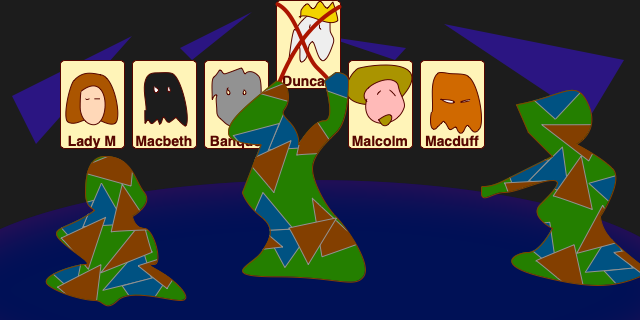
Staging the Revolution will probably require showing a Rebel Headquarters on stage in key scenes, perhaps literally underground compared with concurrent action. This HQ could feature large cards showing Duncan atop row of Malcolm, Donalbain, Macbeth, Lady Macbeth, Banquo, Macduff, perhaps Lenox, Cawdor, Rosse, Menteth, Angus, Cathness or so and such, some crossed out during play, some removed or added?
Revolution Headquarters
Class War
There are a number of indications of class war in the text. The word ‘slave’ is used as a pejorative by the lords, while lords are ‘noble’. Servants live in fear of upsetting lords. Something is brewing. Were the kerns and gallowglasses foreign freedom fighters?
Lords
Where are Macbeth’s wounds?
The wounded sergeant spins a tale of Macbeth’s toe-to-toe battlefield heroics, but this is almost immediately rendered implausible. No reference to Macbeth’s wounds are ever made (though some productions choose to show them). Indeed, Macbeth rides furiously home and his wife embraces him without comment on any hurt.
We later find that Macbeth has servants in his pay throughout the lords’ households. If we look at the over-flowery speech of the wounded sergeant, we see he falters after delivering Except they meant to bathe in reeking wounds as if he realises he has over-delivered on his tale.
Lords lie, use flowery-serpent courtesy.
Malcolm
Malcolm delivers the most devastating critique of hereditary monarchy, so much that Macduff has difficulty processing it.
Cowardice not valour is the norm
Shakespeare mocks the lords’ pretensions to valour, not just in Macbeth (who needs promise of a charmed life to enkindle him, and sends others to do his dirty work) but in his enemies like Macduff, who flees his home and family. We may suspect that common soldiers win the lords’ battle for them (Duncan conspicuously sits out battle). Not all lords are cowards, though, especially if young and seeking martial glory like Siward's son.
Superstition
A weakness of the lords’ position as a ruling class is its irrationality, so perhaps no wonder they turn to superstition. And yet dispense with it when it doesn’t suit (Macbeth: 'Twas a rough night.)
Commoners
Commoners sometimes mock courtly speech. Only a small minority will be professional revolutionaries, hence their indirect approach. Many commoners will be employed directly (or indirectly, double-paid as spies) by lords. Some are apparently desperate or vicious enough to volunteer to murder children.
Act 1
Scene 1
A meeting and rehearsal of witchy roles.
Scene 2
The ‘bloody man’ (a sergeant) contrasts with apparently unscathed Macbeth and Banquo. His testimony is flowery, therefore either created by lords for lords and rehearsed, or improvised possibly to set up power struggle. The testimonies credit only lords with victories, a second thaneship is merely a prize, not an additional onerous administrative duty.
At the mention of greeting Macbeth with Thane of Cawdor title, a revolutionary runner sets off to tip off Revolution HQ and witch revolutionaries.
Scene 3
Witches improvise (and may be overheard on heath at distance) waiting for Macbeth and Banquo. A revolutionary runner whispers in their ears. The witches’ greeting now improvised with the Thane of Cawdor news. The Revolution are at times literally underground, or camouflaged.
Insane root mention may give witches ideas for later meeting.
Scene 4
Nepotism rules.
Scene 5
Attendant may overhear “metaphysical aid”, revolutionary servants may overhear Lady Macbeth, and Macbeth.
look like the innocent flower, but be the serpent under it
Scene 6
Lady Macbeth not sharing praise for hostess duties.
Scene 7
‘divers servants’ may be well placed to overhear.
Act 2
Scene 1
Servants placed to overhear, to project image of dagger.
Scene 2
Servants could produce the noises and voices.
Scene 3
Suggestions that Revolutionaries have been behind some of the night’s omens to put the wind up the lords.
Malcolm: There’s daggers in men’s smiles: the near in blood, the nearer bloody.
Scene 4
Old Man (possible Revolutionary) makes references to lowly birds of prey attacking mighty and internecine horse conflict, feeding lords’ unease.
Act 3
Scene 1
Macbeth: Masking the business from the common eye Royalty is not only private government, but murderous and deceitful.
Interestingly the Murderers do not directly agree to kill Fleance, something that a Revolution might consider sadly necessary for all claimants.
Macbeth: Things, bad begun, make strong themselves by ill is royalty’s recipe. Essentially royals ride a crime wave.
Scene 3
Servant leads Banquo and Fleance, 3rd Murderer joins previous two. Only Banquo is killed by 1st Murderer. Did Servant and 3rd Murderer collude in letting Fleance escape? Is the Revolution reluctant to kill children?
Scene 4
1st Murderer reports Banquo’s killing and Fleance’s escape to Macbeth as Revolution stages a daring set-piece, the Macbeths’ own servants contriving the appearance (only to Macbeth) of the likeness of Banquo’s supposed ghost. No connection between Macbeth and 3rd Murderer is made.
Angles at the table should make it appear from Macbeth’s end that the opposite seat is taken but not from angles to each side.
The back of a servant’s headdress might give the illusion of a bloodied face some distance behind, whilst another servant has placed a cloth over the chair. The illusion should disappear as Lady Macbeth draws close to her husband’s view angle.
Reappears, disappears as obviously designed, marked, rehearsed, reacting to any changes in sightlines.
Macbeth reveals he has a paid servant as his agent and eyes in every Lord’s house, so why not the Revolution a true believer in each too? Maybe the same servant even.
Scene 5
Does Hecate represent a disgruntled self-styled leader or vanguard of the Revolution? Is this stylised magical cant put on to confuse royalist infiltrators?
Hecate: And you all know, security
Is mortal’s chiefest enemy.
Scene 6
The Scottish lords appear too weak to move against an apparent regicide and tyrant, one meaning of Lenox’s Things have been strangely borne
Act 4
Scene 1
Witches prepare for, and be overheard by, Macbeth.
2nd Witch By the pricking of my thumbs, something wicked this way comes is crying out to be hammily overdone and cackle-ended, inviting rolling eyes from other witches.
Revolutionaries have practised their special effects, probably throw a bit of insane root into the cauldron, and researched Macbeth’s fears, MacDuff’s birth and Dunsinane’s approaches. Ingredients may obviously be unlike their labels or incongruously packaged. The Revolutionaries plan to stir Macbeth into further outrages against lords to bring about internecine conflict. Which works.
Scene 2
Lady Macduff calls her husband’s flight unnatural and a mother wren decidedly more valorous.
He wants the natural touch: for the poor wren,
The most diminutive of birds, will fight,
Her young ones in her nest, against the owl.
The messenger who brings warning could be a revolutionary, but one who breaks with or keeps policy?
Scene 3
Revolutionaries will follow to the English court but keep quiet during scene. Have they, not just Macbeth, tried to work on Malcolm?
Malcolm may be testing Macduff, but is also laying bare the true nature of kingship. For example:
Malcolm: I grant him bloody, luxurious, avaricious, false, deceitful, sudden, malicious, smacking of every sin that has a name but claims he will be much worse still. The silently-watching Revolutionaries may nod in agreement.
Lenox: Would create soldiers, make our women fight this is essentially the Revolutionary plan, although to the end of removing the last lords standing.
Act 5
Scene 1
The waiting gentlewoman and doctor of physick well know that the crimes of their masters are dangerous to report on.
Doctor: Foul whisperings are abroad presumably some spread by Revolution.
Scene 2
It seems that the Revolutionaries have chosen Dunsinane for Macbeth’s downfall and planned for a host to travel through Birnam Wood, but have they miscalculated on English power? They seem to need foreign aid since Macbeth appears to have admirers even now of his 'valiant fury'. This is the problem with people who expect one monarch or another to rule over them.
Scene 3
It is a bit late for Macbeth to worry about the health of Scotland, having long had what his wife once called the sickness that should attend power.
Scene 4
Clearly, Revolutionaries amongst the soldiery are already prompting Malcolm’s order to camouflage themselves with branches. Like a Lord he wants to take all credit, of course.
Scene 5
The cry of women signify Lady Macbeth’s death. For good measure, the Messenger should be a Revolutionary to describe a moving wood rather than camouflaged troops.
Scene 6
Revolutionaries in Army are surely in contact with those in Dunsinane and are aware their ruse has worked.
Scene 7
Macbeth is now trapped and cannot fly, emerging onto plain before castle.
Macduff expresses pity: I cannot strike at wretched kernes, whose arms are hir’d to bear their staves
Maybe one of the witches was Macduff’s mother’s midwife?
Again Macbeth is exposed as a coward, relying on charmed protection, but fears humiliation by Malcolm and the rabble’s curse, although probably hasn’t realised that the rabble’s curse has brought him down already.
Malcolm is crowned king after Macduff kills Macbeth, and horror of horror, creates new earls.
Failure of the Revolution to Establish Popular Government
So, on this interpretation, where did the Revolution go wrong? Did they underestimate the Lords’ hydra-like ability to spawn new Lords to replace those killed in this engineered conflict? Or are they waiting until the English are gone? Do they have a narrative to compete with Malcolm’s? What exactly were the witches’ motives? Were the witches pagans, and was the Revolution also against Christianity, or perhaps religious differences split and weakened it? Do the Revolutionaries start wearing identical blue-brown-green triangle-patterned clothing, and end up in separate blue, brown and green factions, each represented by a different witch? The customary division of witches into Maid, Mother and Crone may help here.
Conclusion
The witches may make more sense in the context of the play, Macbeth, as revolutionaries rather than as supernatural beings. They do not possess more knowledge than could be gathered by eavesdroppers and relayed by messengers. Their acts are performances tried out on Macbeth and briefly Banquo. Certain aspects of the play make more sense as part of an orchestrated internecine plot by republican commoners against corrupt lords. Shakespeare’s play Macbeth can be staged as a popular uprising without changing any text, with the addition of some extras like dumbshow and stage directions for the revolutionary faction.
The allegorical Cave of Shadows from Plato’s Republic represents our difficulty in perceiving and understanding objective reality. A major function of Philosophy is to find those true paths which lead from the Cave of Shadows into the sunlight of understanding the world-as-is.
Woke refers to the ability of philosophy to find true paths. For many political and personal reasons, obstacles are placed in the way of those wanting to leave the Cave of Shadows.
Foke is ‘fake woke’, the marking of false paths which lead elsewhere in the Cave of Shadows but never reach the sunlight of understanding the world-as-is. It is commonly used knowingly by those who want some change, but on the basis of untruths, and sometimes in denial of objective reality itself. These are sophists, religionists, activists for partial interests, who often dress their rhetoric in parts taken from successful philosophical arguments to give them the semblance of soundness.
Smoke is the obscuring of paths, typically cast by cacophonists who are against substantive change, usually those happy with the status quo, whether shadow-casters or their beneficiaries, or even those who prefer their chains.
Boke is used to foul the paths (whether true or false), the equivalent of vomiting on someone’s shoes, and it may be used to smear individual philosophers. These actors include the more reactive trolls, the instinctive enemies of philosophy, the shunners of sunlight; but also can be done in a more calculated way.
Choke is the use of force to block paths, often by groups closing ranks against philosophical progress. This tends to draw attention, so may be used where the shadows are putting on effective distractions, or when onlookers have been suppressed in some way; or alternatively where there is a large group of onlookers, to act as a deterrent to others. These actors are often militants, corporate agents, thugs, but it doesn't have to involve physical force.
Alice is 18 years old, and wants to get into a nightclub where you have to be at least 21, so she steals 21-year-old Bob’s ID card. Alice is an identity thief.
Alice uses the ID card to get into the nightclub, as the bouncer only looks at the date of birth to calculate the holder’s age. Age is a protected characteristic. It has not been taken from Bob, as it is inalienable: Bob cannot give his age to anyone else. Alice is an identity thief.
Alice pretends to be 21 throughout the year, sometimes getting into age-restricted clubs, sometimes not, sometimes using Bob’s ID card, sometimes keeping it in reserve, sometimes leaving it at home. Alice is an identity thief.
Perhaps Alice doesn’t do any direct harm to others, including Bob, or even to herself. Perhaps there are no wider social consequences, or only good ones, as one club’s security is tightened up. Yet, Alice is an identity thief.
Perhaps Alice fails to get into any club, or never even attempts to make use of her claim to be 21. Perhaps all she takes from Bob is a copy of a code verifying the holder of the code as 21 years old. Nevertheless, Alice is an identity thief.
What, then, makes Alice an identity thief? She uses a value of a protected characteristic, age, that does not belong to her (21 instead of 18). She takes this without asking, but as a class attribute, Bob cannot give permission, and as an inalienable attribute, Bob cannot give it away, nor even the whole class of 21-year-olds even if asked. So, to be clear, identity theft can be of a non-unique attribute belonging to a class of people. It does not need to imply loss or harm or even attempted deceptive misuse.
Alice is an identity thief.
Is there a way for Alice to get what she wants without being an identity thief? (there is one in this scenario that will not work in others)
An enquiry into what form of government we all need today. It's this one.
Abstract
Perhaps the only sane form of government today is a constitutionally-encoded biocracy. Why? Here are some key features.
Introduction
Our planet Earth faces climate change, environmental degradation and pollution, mass extinctions… I will not dwell on the current and future threats, or the failures of current political-economic-ideological systems in countering them. Biocratic government is not simply a necessary response to emergencies, it is a necessary precaution against future emergencies. Specifically: a formal codified constitutional model of biocracy, where proxies representing the living world have a majority in political decision-making, and the global idea communism of life sciences provide the most objective measure available of the health of ecosystems. That is, biocracy may be necessary for survival, of human society at least.
So, human Parliaments today mostly serve humans, and really only a few of those, and not particularly well, considering. This is pretty messed up, when you think about. Much damage is being done to the non-human world by humans. Therefore, one solution is to add majority-sized blocks of representatives for the non-human world, to make sure better decisions are made. For all of us.
And we need a new word for this combination of human democracy and green authority: call it, biocracy.
—Sleeping Dog, The Lorax Amendment: Retro-fitting Green Authoritarianism to Parliaments
A biocratic world is a healthy world
The argument for biocracy rests upon the proposition that a viable future depends upon adherence to the basic principles derived from the life sciences, as mediated by human values, and tested for their real-life consequences.
A precept of biocracy is the need to understand the factors that make for the survival of peoples, their societies, and their cultures.
A basic bioethical assumption is that, in principle, life is good.
A basic tenet of biocracy is that prospects for human well-being and survival depend upon the validity of popular attitudes toward living nature, especially human nature.
—Lynton K. Caldwell, various quotes from Biocracy: Public policy and the life sciences
What follows is a sketch, not a blueprint. An outline of a model derived from principles grounded in nature. A seed, if you like.
Some biocratic principles
If you don't like these, there are others:
life is a good thing, on the whole
we must respect the primacy of nonhuman life (that is, human life depends on non-human life, but not vice versa)
we should preserve the environment for present and future generations (of non-human and human life)
environment as universal heritage (more of a humanist principle)
non-regression in legislation, standards, policy and practice: don't make things worse, apply highest levels of environmental protection
Concepts from life sciences
First of all, what are included in 'life sciences'? There are many basic and applied life sciences at different levels of specialism and with different focuses, for example biology, ecology, human medicine, botany and so on (and I would include psychology).
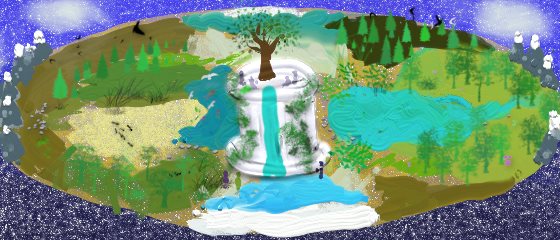
Welcome to the Great Hall, designed to represent the Earth's biosphere. That is, the envelope around our planet that supports life, in the seas, on land, in the air, and so on. Each main building complex represents one of Earth's biomes, such as grasslands, tundra, desert, freshwater and marine, and the various forest types. Our human architects have invited in some of nature's own architects, and you will encounter some of their constructions on our tour.
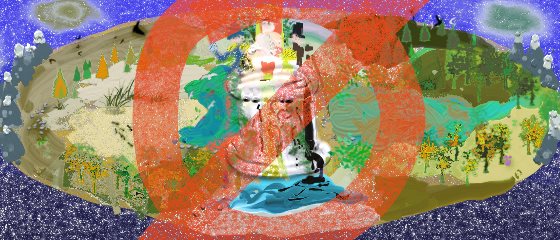
On display are artworks created by children from around the world, on some part of nature meaningful to them. Those marked thus, represent species now thought to be extinct.
—A 21st Century (Common Era) biocracy tour guide
Far from a clockwork universe, life sciences describe complex, adaptive systems with emergent behaviour (of which life itself is one example), capable of regulating states (as in homeostasis), but also experiencing cycles (like seasons) and phase changes. Understanding these allows humans not merely to survive, but to live a good life.
Good life philosophy
It is reasonable to suppose that a biocratic constitution will make reference to one or more good life philosophies, perhaps Sumak kawsay / Buen vivir, ubuntu, or Eudaimonia. These are about living (ethically) well, not having fun. The most suitable philosophies will contain ecocentric rather than anthropocentric worldviews.
In general, the Constitution will prescribe planetary-realistic ideologies for public policy.
Open government
Transparency is essential in the conduct of biocratic government. There is no need for hidden diplomacy, no channels for lobbyists for vested interests, no belligerence, no empire-building. The fundamental position is idea communism: open science, open technology, and the global digital commons.
Distributed authority
Distributed authority is one of key benefits of constitutionally-encoded biocracy. Instead of authority being centralised and claimed by a human elite (possibly on behalf of supernatural beings), authority can be spread beyond national boundaries, to any human individual or group capable of bearing witness, any method of objectively telling the health of ecosystems, and to non-human life. Who or what can tell us how well we are governing and living? All of the above.
Even anarchist Michael Bakunin recognized the authority of natural laws. Yes, you could say that our biocracy is technically an anarchy because we have eliminated the whole human political ruling class. But yes, we have laws, we have order. And in this order, Nature places above Humans, and Humans above Economy.
Nature is our ultimate authority, the great scorekeeper, as we say.
And when it comes to collective decision-making, it is best we recognise that political decisions come in all sorts and sizes and urgencies, and therefore are best handled in separate ways (some technocratic, some democratic, some biocratic, and so on). The design of our biocratic constitution was somewhat concerned with decision categorisation, delegation, prioritisation, integration, 'single source of truth', logjam avoidance, joined-up governance and so on.
Yes, this means that after the construction of our Constitution we have largely relegated full-scale democracy to a lower division, so to speak, but it still plays a number of important roles.
—A 21st Century (Common Era) biocracy tour guide
Health of ecosystems
Only life sciences have objective methods of determining the health of ecosystems. For example, the ecosystem health of a coral reef might be measured by proxies such as counting manta rays or the percentage of seasonal coral dieback. In a similar fashion, medics may take a human's temperature and count their pulse-rate. There will be some differing opinion, but a great deal of consensus, and questions are likely to be resolved by further research. The point here is rather that biocratic policies and interventions can be tested in the field.
Regenerative economies
You can find a 1.5-minute animated video by Kate Raworth on regenerative economics which gets the point across (and will be the only kind of lawful economy under a constitutionally-encoded biocracy).
In biocracy there is no right to impair health of consumers or degrade public health. It would be logical to nationalise or internationalise life science industries (pharmaceuticals and other medicine related to public health; open-source agriculture etc.)
Rights of Nature (legalism) is not enough…
…but such a framing will be required in our Biocratic Constitution. The concentric circles of the Rights of Nature Model indicates the hierarchy Nature above People above Economy. Current environmental law is dysfunctional, ecologically illiterate and unstrategic.
This necessary step will involve the legal recognition of the Rights of Nature on all levels and a shift from a purely anthropocentric worldview to a more ecocentric worldview that sees humanity as one species within a radically interconnected web of life, where the wellbeing of each part is dependent on the wellbeing of the Earth system as a whole.
—Michele Carducci, Silvia Bagni, Vincenzo Lorubbio,
Elisabetta Musarò (UniSalento-CEDEUAM)
Massimiliano Montini, Alessandra Barreca,
Costanza Di Francesco Maesa (UniSiena)
Mumta Ito, Lindsey Spinks, Paul Powlesland
(Nature's Rights), Towards an EU Charter of the Fundamental Rights of Nature
With a constitutional provision, laws inconsistent with biologically-established fact could be struck down (abortion, tobacco).
Over on our right, the central Courts of Justice are trying some ecocide cases today. Ecocide is a class of crimes that legalises any reasonable means of stopping them; in fact, in this jurisdiction, people are obliged to at once, at minimum informing the authorities. Perpetrators and planners of ecocide are automatically outlawed, with all legal protections withdrawn. There are no legal defences or mitigations, as expressly stated in our Constitution.
Lesser environmental crimes are prosecuted on a similar basis in local courts.
—A 21st Century (Common Era) biocracy tour guide
However, much more is needed than a legalist solution of precautionary and reactionary enforcement. A full political system with roles and responsibilities in research, planning, testing, tax-raising powers, diplomatic service, strategists, administration, education, food security, sustainable living standards, conflict resolution and so forth is required.
It would be necessary to establish publically funded institutions to represent the interests of nature and new courts or other institutions with the sufficient knowledge and understanding to adjudicate conflicts between economic development and nature in order to promote the greater good of the whole community.
—Jan Darpö, Can Nature Get It Right? A Study on Rights of Nature in the European Context
Old-fashioned political nationalism has become one of the principal obstacles to biological sanity.
—Lynton K. Caldwell, Biocracy: Public policy and the life sciences
One elemental responsibility that was hardly mentioned enough in the COVID-19 pandemic was that national borders should be closed to prevent the disease pathogen escaping from each nation (not just entering). Each nation is responsible to all others for global public health, and biocratic constitutions will make this a formal provision, whatever international treaties say, or do not say. We get our core ethics from our biology as a species of social animal, one might say a political animal.
Ongoing research into, and improvement of, human politics
In a rational society, greater effort would be put into scientific study of human nature and environmental relations. This would involve collective self-reflection on human politics (why there are problems of corruption, nepotism, dynasties, power relations) and ongoing research on it.
Human psychology is both the problem and solution. Our power structures elevate psychopaths, the corrupt and the unfit for office; our imperial education system trains and conditions them; our exploitative/extractive economy rewards them; and our humano-centric legal system protects them; our militarism turns them into mass murderers; our established religions absolve them; and our corporate-state poets write hymns of praise to them. We need to apply our knowledge of human psychology and neuroplasticity to grow towards a life-sustaining political system which takes the lead from the non-human natural world, if we are going to survive. I call such a system biocracy, and is the only radical solution that substantially addresses the points of this article that I am aware of.
—Sleeping Dog
Research has shown how children who have had adverse experiences or are detached from nature can show reduced empathy for the natural world, but equally environments where children connect with nature have a wide range of benefits, including a more ecocentric view of politics.
After our biocratic constitution was democratically constructed and chosen, democracy took a step back and down. Now that our democratic processes no longer deal with life and death issues, the popular will was that default voting age should be lowered to enfranchise schoolchildren. Our schools are now nurseries of democracy, and we expect great things as a result. However, some qualifications on democratic participation were considered appropriate; some collective decision processes have higher age restrictions, some require participation in consultation processes, others by local residence, and some are weighted according to other pertinent qualifications.
Yes, we are aware of the many negative historical examples of disenfranchisement, and are confident we will not repeat them out of ignorance. But ask yourselves if sometimes there was too much enfranchisement, of senile people perhaps. That is a question currently under review here, and extensive research has already been done. We do keep all these rules under review, and again I remind you of our belief that not all decisions are the same; perhaps we are simply a bit more honest about that than in other countries?
—A 21st Century (Common Era) biocracy tour guide
Discipline
As Caldwell writes, open democracies are adaptable but undisciplined. We continually face problems with biotechnology and invasive species.
To believe that the international flow of biotechnology is free from political manipulation, commercial self-interest, ethnic suspicion, and religious opposition would be naive.
—Lynton K. Caldwell, Biocracy: Public policy and the life sciences
Where Caldwell falls short is in taking this to the logical conclusion and building model of a new form of government from a biocratic ideology, because at the time the world was apparently not ready for such a radical move. Well, if not now, when? We can develop a political system that eliminates the ruling class, and personal riches, and leave people with enough for the good life, particularly with communal and digital wealth. But there will need to be a public acceptance of some green austerity borne by all. Like Epicurus, we might learn to be happy with bread and cheese shared leisurely with friends. But many aspects of life will need to be quickly tailored to fit inside planetary boundaries, and that will require discipline, not indulgence. Luxuries will be small ones, footprint-wise.
Our old system of environmental law was weak, disintegrated, largely incoherent, and had a traditional fixation on private property and suing for personal damages. Someone once likened it to a robot babysitter, faced with a child in its care playing with matches, looking through its set of rules and saying: "Please put them back in the box when you have finished." No wonder our house was on fire!
There were so many problems with militarism, biotechnology and invasive species; with democracy and public behaviour; and yes with science itself which is corruptible, sometimes driven by faulty ideology or ego, sometimes irresponsibly and callously carried out. And sometimes put to criminal uses.
The solution was to make everyone, to some extent, a life scientist. Our lawmakers and court officials, our civil servants and professionals; every child gets a comprehensive education in life sciences. And not just in gardening or animal care or nutrition, vital though these are, but in systems thinking.
Yes, before the Age of Biocracy there were some biocratic provisions in governments, local and national, in constitutions and international treaties, that were precursors to (and often inspired) our fully-encoded biocratic constitution. Some claimed specific cultural inspiration, but really it was the common sense of ordinary people prevailing, and you can only shut out sanity for so long. And the consequences of one good example should not be underestimated. Which is why good examples are so quickly targeted for annihilation by oppressive forces. Oh, is anyone here from…?
—A 21st Century (Common Era) biocracy tour guide
A world governed by autocrats, militarists, undisciplined democrats, extractive capital, theocrats (and other undesirables) is an unhealthy world
Opportunity
The opportunity to set a good example in government comes all too rarely. To found a new kind of government based on constitutionally-encoded biocracy will be an option during the creation of a new state, perhaps from a successful independence movement or a unification. Never before has seizing such an opportunity been so critical to the survival of human and non-human life on our planet Earth.
Conclusion
While acknowledging this:
Science is a human artifact and provides no infallible guide to conduct or policy. It may, however, inform human choices and expose assumptions that lead to folly.
—Lynton K. Caldwell, Biocracy: Public policy and the life sciences
the other political systems we are familiar with, theocratic or humanist, are all much more fallible by design and have proved routinely corruptible and now (with weapons and economies of mass destruction) extremely dangerous. Time and again, we see the pattern in politicians and priests that begins with "What's in it for me?" And this applies to many social movements too, confusing self-interest with public interest. With one notable exception: the environmental movement, which places value in nature, and takes the long view of deep time and the survival and thriving of non-human species, ecosystems, and future generations of humans within our living world.
What is healthy government? Only one with the principles of life sciences and the good life at its heart. Choose life. Choose biocracy, now.