Showing posts with label tragedy. Show all posts

Thursday, 2 May 2024

Shakespeare’s Romeo and Juliet as a cautionary tale

Abstract

Almost everyone we encounter in the play bears some responsibility for the ensuing multi-death tragedy.

Introduction

Almost everyone in the play contributes to the tragic deaths of young people. A story not so much about love but a call to change a society where your actions, inactions or mistakes can kill you or someone else. Other named characters such as Rosaline are blameless and therefore do not appear.

A warning sign depicting abstract images of Romeo wooing Juliet, in front of walled Verona.
Warning: unauthorised wall-scaling and poetic pickup lines in progress

First, we will run through Romeo and Juliet the play and pick out relevant moments.

Then, we will analyse themes and language.

Finally, we will say what the play is not, before tendering our conclusion.

Notes on language

In this article, 'parents' is used as a shorthand for parents/guardians/primary caregivers and all comparable roles. In the play, the parents of interest are the couples: Montagues and Capulets.

Key Quotations from the Play, with Brief Notes, Scene Summaries and Questions

Prologue

Here we encounter the ancient grudge that informs the rest of the play.

Act 1

A1s1 Capulet servants Sampson and Gregory exhibit bravado, belligerence and sexualised threats; they pick a fight with servants of Montague with foreknowledge that this quarrel may lead to tyrannous behaviour and harm to innocents. Sampson: Draw, if you be men Benvolio tries to keep peace.

Tybalt: “What, drawn, and talk of peace? I hate the word,
  As I hate hell, all Montagues and thee:
  Have at thee, coward.”

Tybalt especially shows wilful misinterpretation to exaggerate threats to justify violent response. Citizens seek to put down brawl with clubs while Capulet calls for long sword to match Montague. Prince threatens them with torture and death:

Three civil broils, bred of an airy word,
By thee, old Capulet and Montague,
Have thrice disturb’d the quiet of our streets;

Far from fray, Romeo tells Benvolio of his groaning unrequited love for a woman who has forsworn love.

A1s2 Paris sues Capulet for his daughter’s hand but Capulet says she is too young:

My child is yet a stranger in the world,
She hath not seen the change of fourteen years;
Let two more summers wither in their pride,
Ere we may think her ripe to be a bride.

but will see if she will become amenable. Do characters simulate more in verse? Servant cannot read list of party guests: is illiteracy a contributory factor to civil ills? Literate characters may manipulate illiterate ones. Benvolio names Rosaline as Romeo’s love.

A1s3 Nurse reckons Juliet’s age a fortnight and odd days short of 14 years, a similar age to her own dead daughter Susan. Lady Capulet tells Juliet she was married at a similar early age and other ladies are already mothers by 14 so Paris?

Juliet: “I’ll look to like, if looking liking move:
  But no more deep will I endart mine eye,
  Than your consent gives strength to make it fly.”

We discover over time that Juliet is under intense and urgent pressure to conform to her parents’ wishes, which transmit to servants.

Servant: “Madam, the guests are come, supper served up, you called,
  my young lady asked for, the nurse cursed in the pantry, and every thing in extremity.
  I must hence to wait; I beseech you, follow straight.”

A1s4 Romeo prepares to gatecrash his familial enemy’s swanky party, bolstered by banter. Mercutio’s intense and rambling speech seems sign of a disordered mind; perhaps he fears he cannot speak clearly and plainly even to his closest friends.

A1s5 Romeo sees Juliet and mentally dumps Rosaline. Tybalt, overhearing him, storms but is checked by Capulet, who is strangely well-disposed towards Romeo, or at least wants his party to go smoothly. Romeo and Juliet flirt, until Nurse reveals her to be Capulet’s heiress daughter. As Romeo leaves, Juliet learns his identity (stranger in the world, remember).

Act 2

A2s1 Romeo scales Capulet’s garden wall, ditching friends and their possibly restraining advice.

A2s2 Romeo overhears Juliet pining for him, they talk of peril, their families’ enmity, love, oaths, marriage all with unseemly precipitous haste and on very little acquaintance. This unfathomable speed and secrecy is a caution in itself: who knows what young ones are up to? Romeo seeks collaborator in Franciscan Friar Laurence.

A2s3

Friar Laurence: “Be plain, good son, and homely in thy drift;
  Riddling confession finds but riddling shrift.”
Romeo: “Then plainly know, my heart’s dear love is set
  On the fair daughter of rich Capulet:”

Friar ridicules Romeo’s prior doting on Rosaline, says young men love with eyes not hearts, but because he has another motive (ending the feud) he agrees.

A2s4 Benvolio and Mercutio talk of duels and Tybalt’s fencing prowess. Romeo jests, Nurse arrives from Juliet, they arrange secret wedding for afternoon.

A2s5 Juliet is impatient that Nurse who left at 9 is not back before noon. Nurse arrives, spins out her tale of Romeo arranging wedding at Friar Laurence’s cell. Juliet: Hie to high fortune! — honest nurse, farewell.

Is the Nurse honest if she doesn’t tell her employers she is helping Juliet marry secretly in opposition to their choice?

A2s6 Friar: These violent delights have violent ends, yet marries Romeo and Juliet in secret haste; perhaps also feels they will sin if left alone.

Act 3

A3s1 Mercutio says Benvolio will attack a harmless waiter after two cups of wine and quarrel over anything. Benvolio replies Mercutio is worse. What is the cause of their distemper? Tybalt arrives and it kicks off, Romeo arriving, Benvolio attempting to calm. Mercutio thinks Romeo’s pleasant response to Tybalt’s hate is appeasement. Mercutio, dying, curses both houses. Incensed, Romeo slays Tybalt in revenge, then flees. Benvolio gives accurate account to Prince, who banishes Romeo on pain of death. Prince: Mercy but murders, pardoning those that kill.

A3s2 Juliet waits impatiently for Romeo, Nurse appears with cord ladder and news that someone (Tybalt) is dead, Romeo banished, while Juliet imagines dying, and that Romeo’s beautiful outside hides an opposite nature. They agree Nurse will bring Romeo.

A3s3 Romeo also takes news from Friar of banishment with melodrama, at length. Nurse arrives and with Friar eventually shame some sense into Romeo: to Juliet, then Mantua to await developments.

A3s4 Capulet still wants to hurry Juliet’s wedding with Paris, who can hardly wait. Fewer guests out of ‘respect’ for Tybalt.

A3s5 Juliet and Romeo, marriage consummated, tarry in her bedchamber. They part thinking on death again. Lady Capulet thinks Juliet cries too much for Tybalt, says she’ll send a poisoner to Mantua to kill Romeo in revenge. Juliet is shocked by the ‘haste’ her parents want to see her wed Paris.

Juliet: “I wonder at this haste; that I must wed
  Ere he, that should be husband, comes to woo,”
Lady Capulet: “I would, the fool were married to her grave!”
Capulet: “Out, you green sickness carrion! out, you baggage!”

Nurse stands up for Juliet:

God in heaven bless her! —
  You are to blame, my lord, to rate her so.
Capulet: “An you be mine, I’ll give you to my friend;
  An you be not, hang, beg, starve, die i’th streets,”

Juliet seeks delay or death; parents leave and she seeks comfort from Nurse… who, likely thinking on her own dead Susan, betrays Juliet by switching to back Paris and an unrealistic living make-do. Juliet pretends to relent, Nurse leaves to tell Capulets good news.

Juliet: “Ancient damnation! … Go, counsellor;
  Thou and my bosom henceforth shall be twain.”

Either the Friar will help, or Juliet considers taking the suicide option.

Act 4

A4s1

Friar: “You say, you do not know the lady’s mind;
  Uneven is the course, I like it not.”

Paris claims Capulet thinks Juliet’s grief for Tybalt is dangerous, and hasty marriage a cure. Juliet arrives and easily gets the better of Paris, dismissing him and saying Friar better have a solution to Romeo’s banishment, or she’ll kill herself:

I long to die,
If what thou speak’st speak not of remedy.

Friar offers a desperate, daring, dangerous hope. Fake your death, Juliet! Juliet eagerly accepts his offered drug.

A4s2 Juliet feigns obedience to Capulet who accepts her volte-face explanation that Friar taught her obedience in one session.

Juliet: “Henceforth I am ever rul’d by you.”
Capulet: “my heart is wondrous light,
  Since this same wayward girl is so reclaim’d”

A4s3 Juliet wonders if she should call back Nurse and mother, or drink the unknown drug, or kill herself with dagger?

Juliet: “What if it be a poison, which the friar
  Subtly have minister’s to have me dead”

to avoid dishonour for Romeo marriage. What horrors might confront her in the tomb? She drinks.

A4s4 The Capulets and servants are busy with wedding preparations, the external forms of the planned relationship.

Capulet: “Go, waken Juliet, go, and trim her up;
  I’ll go and chat with Paris: — Hie, make haste,”

A4s5 Nurse tries to waken Juliet, fails. She, Capulets, Paris, household bar Friar think she’s dead. Lamentation (and some nasty blame from Paris). Friar: think of it as a promotion.

Act 5

A5s1 In Mantua, Romeo dreams of death, then learning of Juliet’s ‘death’ and burial seeks poison from desperate apothecary:

Such mortal drugs I have; but Mantua’s law
Is death, to any he that utters them.
Romeo: “I pay thy poverty, and not thy will.”
  “There is gold, worse poison to men’s souls,
  Doing more murders in this loathsome world,
  Than these poor compounds that thou may’st not sell:”

(which didn’t put Romeo off the fair daughter of rich Capulet!)

A5s2 Friar learns his letter never reached Romeo in Mantua and hastens tombward.

A5s3 Why exactly does Paris hope to gain by sneaking into Juliet’s tomb? Romeo says he is going to see Juliet’s face…

But, chiefly, to take thence from her dead finger
A precious ring; a ring that I must use
In dear employment

but servant Balthasar has his doubts and hangs about. Paris sees Romeo as Montague who partly caused Juliet’s death by killing Tybalt. They needlessly fight, Paris ignoring Romeo’s plea to leave, Romeo kills Paris, sees, speechifies to and kisses Juliet, then drinks poison and dies. [only seconds too soon…] Friar arrives too late, talks with Balthasar.

[Events appear to be taking on a dreamlike quality] Juliet awakes but Friar fails to rescue her, if secretly stuffing her into a nunnery counts. Poison failing, Juliet stabs herself to death with Romeo’s dagger. Watch apprehend Friar and everybody else turns up for a gawk. Prince holds an impromptu court; Friar and others testify, Romeo’s letter corroborates. Prince lays blame on feuding Capulets and Montagues, who say they’ll patch up quarrels, raise statues and make amends.

Prince: “And I, for winking at your discords too,
  Have lost a brace of kinsmen: — all are punish’d.”

Prince doesn’t yet specify who will be further punished or pardoned, at least implying the form of due process.

Themes and Language

Given this reading as a cautionary tale, it is essential to include language on themes such as suicidal intentions, since these are things that others should be picking up and listening to; and that Juliet’s young age (13 going on 14) be respected (or intervention be too late).

Some other warning signs or contributive factors to the play's tragedies include:

  • Secretive behaviour (both the Nurse and the Friar encourage this, perhaps such encouragement often has comedic results in plays).
  • Sexualised speech (where inappropriate and/or threatening, such as the banter which creates an atmosphere of intimidation or lewdness which is divisive).
  • Unreasonable and excessive haste (a general fault, oft-mentioned word in the play).
  • Quarrelsomeness; aggression.
  • Ulterior motives (civil peace; rich heiress).
  • Displacement, transference, confusion (Nurse’s Susan, see later).
  • Personal pride and ambition.
  • People who think both Romeo and Juliet need to be fixed (I don’t mean neutered).
  • Children who learn to tell parents what they want to hear etc. Juliet lies to father about being ruled by him, but doesn’t bother lying to Paris, instead deftly fooling him. Parents should watch for sudden obedience.
  • Frustrated competition, either banned, unsafe (like duels) or precluded (like courtship).
  • Suppression of other opportunities (to learn, to interact, to show true colours, to escape class or gendered roles).
  • Inconstant counsel (Nurse particularly).
  • Betrayal of trust (Nurse again, though very likely with Juliet's longterm wellbeing in mind).
  • Machiavellian tendencies; meddling (Friar, albeit with perhaps good and sincere intentions).
  • Both young and old can be giddy and serious at the same time — seriousness does not require deep or sustained reflection nor constancy.
  • Sole heirs (especially under dynastic societies, these are typically subject to considerable pressures).
  • Overconfidence; simplification; lack of contingency planning (particularly the Friar).
  • Feuding; grudge-keeping; avenging kin (Capulets particularly, for Tybalt).
  • Deceit.
  • Possibly undue leniency (Prince thinks so).
  • Undeservedly harsh parental treatment (Capulets on Juliet).
  • Emotional blackmail.
  • Religious injunctions on obedience.
  • Autocracy; hierarchy.
  • Lack of empathy.

Is faking your own death ever the answer?

Poverty is not vice but desperation leads people to consider lawbreaking (the Apothecary).

Puberty transforms (Juliet) while parents may sometimes be too slow or too quick to anticipate changes. It is Juliet's linguistic skill, quick wit and pure determination that lets her wrongfoot the adults about her, who all seem to underestimate her (except perhaps Romeo, hence their almost-instant connection).

I won't go through all these aspects in detail, but consider how at any point the play's actions may be changed to avoid the tragedies.

What the Play is Not

Romeo and Juliet is not a love story. Yet one of the first thing Romeo says is that these broils may have as much to do with love as hate (as factionalism and in-out group psychology shows). Without much doubt, the truest love shown in the play appears to be the Nurse's for Juliet, who she treats like a surrogate daughter, always prattling happily on about her and running errands for her. However, even this love is notably imperfect, as the Nurse may be transferring her love for her dead daughter Susan on to Juliet. Indeed, we don't know if the Nurse's anecdotes about Juliet's infancy were not actually (misremembered) incidents from Susan's childhood. And in the crucial pivot of the play, the Nurse breaks faith with Juliet, preferring a 'safer' marriage with Paris and a live surrogate daughter to a Juliet pining over banished Romeo and suicidal ideation.

The play is not a comedy (though it shares some common comedic components, the remaining cast are united in grief not marriage), nor a typical tragedy (yet undoubtedly tragic in key elements). It has action but not of epic scale. It is not the stuff of history plays, yet it could be local history.

Unlike her parents’ choice, Romeo is Juliet’s alone, just as Juliet is Romeo’s alone (call her mine); this possessiveness (a mansion, robes) combines with deathwishes and nightlonging. Capulet attempts minionisation of Juliet. Both Romeo and Juliet seek to avoid traps. At what point in play do caring adults fail to understand Juliet’s inner life? From the very start? Which is mirrored by Romeo’s interiority. Shouldn’t Romeo and Juliet be Goths? Nurse knows what a dead child looks like, as do Capulets. Romeo bespeaks Tybalt and Paris fair but kills both aggressors.

So the story is probably much closer to social realism than the common comedies, tragedies, tragicomedies, epics, histories that Shakespeare's audiences were likely more familiar with. The question is: why?

Conclusion

If Shakespeare wrote Romeo and Juliet as a socially-realistic play, where audience members may have recognised characters like themselves or people they knew, acting in quite believable ways which collectively ended in tragedy, then for what reasons?

I think it is highly plausible that many of Shakespeare's plays are intended in main or part to increase empathy and appreciation of the value of human lives. I've already written something about Shakespeare's blood-savers. One could argue (and I would) that many lives may have been saved over the years by plays such as Othello, which should at least make jealous husbands think twice before murdering their wives (likewise A Winter's Tale, and so on and on).

But in Romeo and Juliet, Shakespeare's focus shifts to children and young people, in the grip of powerful emotions, trapped by circumstance, daring to look death in the eye. I think, quite simply, Shakespeare wants to make us think of them, their worlds, their ambitions, their frailties, their hopes and dreams… and not crush them. Shakespeare's Romeo and Juliet is a cautionary tale. For all of us.

Shakespeare’s Romeo and Juliet as a cautionary tale by Sleeping Dog is licensed under CC BY 4.0

Wednesday, 20 March 2024

Will and Health: two factors of governance in Shakespeare's King Lear

Abstract

How health and will emerge as two interrelated components of governance (self and state) in William Shakespeare's tragic play, King Lear.

Introduction

As discussed before, from the very opening of the play, Lear's Britain is a state with a projected perilous health, yet the solution (neutralising his two eldest daughters who each plot to gain the crown by bloody civil war) is perhaps too unfatherly/impious/legacy-unfriendly/precedent-setting for Lear, who instead engineers a solution to send beloved youngest daughter to safety while the other sisters (literally) duke it out. By retaining one hundred knights and doddering between them, Lear can even Yojimbo-like take the weaker side until both Albany and Cornwall are exhausted and Cordelia can return with powerful French backing.

Old King Lear in right foreground, looking down from balcony on map of Britain surrounded by his three daughters: Goneril and Regan (with husbands) gesticulating, Cordelia bandaging a dog's paw.
King Lear ruminating on the future health and division of his state

First, we will review an extensive series of quotations from the text (included partly because some are frequently omitted from productions of this very long play), with brief notes.

Then we will consider significant ways Health and Will are represented, and how they relate to Governance (both of self and of state).

Finally, we will try to understand what Shakespeare's play is really saying about the nature of Health and Will in Governance, and whether that leads us to reject some political systems in favour of others.

Key Quotations from the Play, with brief Notes and Scene Summaries

A play which takes from 3 to 3½ hours in theatre, says director Richard Eyre of his television movie of Lear, can be cut down by omitting whole or partial scenes, lose 'complicated plots' and compress dialogue, and so on. The full text is a better guide to the issues under consideration, and I cannot recommend any particular production/performance. However, the BBC's version with Michael Hordern as Lear is worth the watch, though it is not my current interpretation of the play.

Act 1

A1s1 Lear suggests his health is failing and he wants to prevent future strife. Cordelia considers love as riches. Lear speaks of The vines of France, the milk of Burgundy, which indicate the health of the states of Cordelia's two suitors.

Lear’s wilfulness (express our darker purpose) has the effect of granting Cordelia a love match and a safe haven, with Kent banished for future team-up. The sway goes to Cornwall and Albany.

Kent: Kill thy physician, and the fee bestow upon the foul disease.

Lear’s sentence overrides his nature To shield thee from diseases of the world with the kind banishments of Kent and Cordelia with those infirmities she owes.

Regan: ‘Tis the infirmity of his age: yet he has ever but slenderly known himself. Goneril: the unruly waywardness that infirm and cholerick years bring with them.

A1s2 What is a healthy relationship between parent and child to the Glosters?

Why bastard? wherefore base?
When my dimensions are as well compact,
My mind as generous, and my shape as true,
As honest madam's issue?

A1s3 Lear's knights riotous, king upbraiding.

A1s4 Steward’s contest of will with Lear. Fools whipped. Ungrateful cuckoo chick. Lear’s sterility curse on Goneril. A dotard in command of dangerous knights.

A1s5 Lear: O let me not be mad.

Act 2

A2s1 Edmund cuts himself to support his lie. Gloster: my old heart is crack’d. Regan: waste and spoil of his revenues.

A2s2 Kent: anger has a privilege.

A2s3 Edgar mortifies himself as poor Tom.

A2s4 Fool says falling leaders stink. Sickness excuse not to meet Lear.

Lear: “Infirmity doth still neglect all office,
Whereto our health is bound; we are not ourselves,
When nature, being oppress’d, commands the mind
To suffer with the body: I’ll forbear;
And am fallen out with my more headier will,
To take the indispos’d and sickly fit
For the sound man. Death on my state!”
Regan: “If, sir, perchance,
She have restrain’d the riots of your followers,
‘Tis on such ground, and to such wholesome end,
As clears her from all blame.”

Lear wishes lameness on absent Goneril. Lear imagines Goneril both flesh-and-blood and a disease in his flesh.

Regan: “What need one?”
Lear: “O, reason not the need: our basest beggars
Are in the poorest things superfluous:
Allow not nature more than nature needs,
Man’s life is cheap as beast’s: thou art a lady;
If only to go warm was gorgeous,
Why, nature needs not what thou gorgeous wear’st, which scarcely keeps thee warm — But, for true need,—”

Cornwall: ‘Tis best to give him way; he leads himself. Gloster protests king lacks storm-shelter.

Regan: “O, sir, to wilful men,
The injuries, that they themselves procure,
Must be their schoolmasters: Shut up your doors;”

Act 3

A3s1 Lear reportedly contends with storm while even hungry predators cower.

A3s2 Lear calls on the will of the storm sulphurous and thought-executing fires to punish himself and others, spilling all nature’s seeds:

Lear: “let fall
Your horrible pleasure; here I stand, your slave,
A poor, infirm, weak, and despis’d old man”
Lear: “My wits begin to turn” Fool: “tiny wit… fortunes fit”

A3s3 Gloster and Edmund discuss the savage and unnatural. Excuse of illness. Gloster: “If I die for it, as no less is threatened me, the king my old master must be relieved.” Edmund: “The younger rises, when the old doth fall.”

A3s4 Kent: The tyranny of the open night’s too rough For nature to endure. Lear: When the mind’s free, The body’s delicate: the tempest in my mind. You houseless poverty Lear to Fool (another indication that the play originally intended the Fool at this point to be Cordelia in disguise).

Lear: “O, I have ta’en
Too little care of this! Take physick, pomp;
Expose thyself to feel what wretches feel;
That thou may’st shake the superflux to them,
And show the heavens more just.”

That is, redistributing wealth is both healthy and just. Edmund/Poor-Tom is tormented and cold, blamed on vice and the foul fiend?

Gloster: “Go in with me; my duty cannot suffer
To obey in all your daughter’s hard commands:
Though their injunction be to bar my doors,
And let this tyrannous night take hold upon you,
Yet I have ventured to come seek you out,
And bring you where both fire and food is ready.”

Gloster: The grief hath craz’d my wits.

A3s5 Cornwall: I will have my revenge.

A3s6 Lear, apparently losing touch with reality, convenes a trial of absent Goneril and Regan. Friends rally round him.

A3s7 Regan, Goneril and Cornwall mean harm to Gloster, approved by Edmund; loyal knights have taken Lear to Dover.

Cornwall: Though well we may not pass upon his life
Without the form of justice, yet our power
Shall do a courtesy to our wrath, which men
May blame, but not control. Who's there? the traitor?

Gloster: You are my guests: do me no foul play, friends. Unnamed servant of Cornwall intervenes to save Gloster’s remaining eye, fatally wounds Duke in fair combat and is fatally backstabbed by Regan. Cornwall finishes blinding Gloster. Remaining servants are appalled by the wilful acts of their ‘betters’.

It is worth noting Gloster's earlier hypocrisy in calling Cornwall 'fiery' when Edmund has so easily stoked Gloster's wrath towards Edgar.

Act 4

A4s1 Gloster: I stumbled when I saw, and As flies to wanton boys, are we to the gods; They kill us for our sport. wanton here is equivalent to wilful. Gloster, humbled, now sees redistribution of wealth as key to health, reducing the diseases of rich and poor alike.

Gloster: “Here, take this purse, thou whom the heavens' plagues
Have humbled to all strokes: that I am wretched
Makes thee the happier: heavens, deal so still!
Let the superfluous and lust-dieted man,
That slaves your ordinance, that will not see
Because he doth not feel, feel your power quickly;
So distribution should undo excess,
And each man have enough.”

Gloster asks Poor Tom (son Edgar) to lead him to high Dover cliff (and leave him).

A4s2 Goneril: Conceive, and fare thee well. Edmund: Yours in the ranks of death. Albany upbraids wife for monstrosity even before hearing of Gloster’s blinding, Cornwall’s death-by-servant and Edmund’s treachery. Albany: Wisdom and goodness to the vile seem vile: Filths savour but themselves.

A4s3 Kent and Gentleman discuss Cordelia’s state on hearing news.

A4s4 Cordelia’s description of Lear suggests latter has been self-medicating with wild herbs. Physician prescribes rest and sedatives. Cordelia fears Lear’s ungovern’d rage dissolve the life That wants the means to lead it.

A4s5 Regan regrets letting Gloster live, as his injuries attract sympathy.

A4s6 Edgar: Why, then your other senses grow imperfect By your eyes’ anguish. (a deception). Edgar: Why I do trifle thus with his despair, Is done to cure it.

Gloster: “Is wretchedness depriv’d that benefit,
To end itself by death? ‘Twas yet some comfort
When misery could beguile the tyrant’s rage,
And frustrate his proud will.”

Lear appears wreathed in flowers. Lear: they told me I was every thing: ‘tis a lie; I am not ague-proof. Lear wants general copulation to provide him with more soldiers. Lear seems to have been energised by partial loss of wits and reconnection with nature away from toxic courts. Steward sees Gloster’s life and death merely means for own advancement.

A4s7

Cordelia: “O my dear father! Restoration, hang
Thy medicine upon my lips; and let this kiss
Repair those violent harms, that my two sisters
Have in thy reverence made!”
———
Cordelia: “Mine enemy’s dog,
Though he had bit me, should have stood that night
Against my fire;”
———
Physician: “the great rage,
You see, is cur’d in him”

Dogs are mentioned a great many times with notable inconsistency in King Lear, but this comment links to a previous quip by Cordelia-Fool. In this case, even the health of a biting dog of an enemy is valued. Rage here is Will-linked, ungoverned; and pacified Lear is no longer giving commands, but regaining health and sense.

Act 5

A5s1 Goneril: I had rather lose the battle, than that sister, Should loosen him and me. on Edmund, who plots his ruthless upwards path.

A5s2 Edgar tries to raise spirits of depressed father again.

A5s3 Lear tells Cordelia they can be happy enough in prison.

Edmund: “At this time
We sweat and bleed: the friend hath lost friend:
And the best quarrels, in the heat, are curs’d
By those who feel their sharpness”

Goneril poisons love-rival sister Regan. Gloster has reportedly died of joy and grief by Edgar’s nursing revelations. Goneril reportedly dies by her own knife. Edgar kills Edmund in challenge, who has just enough time to warn… Too late, Cordelia has been murdered by hanging in cell, Lear killed her murderer. Lear: And my poor fool is hang’d! Lear faints and dies.

Key Concepts

Will

See also Weather, Tyranny, Gods, Sport, Revenge, Excess, Want (there is a double meaning in Want, which can be Need — ie Health — or Desire — more like Will).

Will is associated with emotions, but which ones in particular does the play foreground? Rage is a common theme; Lear, Cornwall, tyrants and storms rage to inflict their will; Kent claims anger has a privilege. But rage seems an enemy to good governance, and in each case threatens health: Lear's exposure, servant mortally wounds Cornwall, Kent is stocked. Lust, in the competition between Goneril and Regan for Edmund, and Edmund for land, leads to the wilful deaths of all three. Grief can also 'craze wits'. Fear (of growing old, becoming sick or injured, or mad etc) is another, linked partly in the play to aging and loss.

Wills can sometimes change like the weather.

Health

See also Need, Nursing, Beasts, Wholesomeness, Disease, Nature, Justice, Mortification, Bastards.

How does loss of health (physical, mental) in one affect others? Edgar as Poor Tom mortifies his own flesh, copying beggars; Edmund cuts himself to support a lie; and as we have seen, Regan says Gloster's injuries attract sympathy. Yet many of the characters also wilfully injure others, or at least plot their deaths.

How does loss of health in oneself affect how you see others? Lear has apparently been oblivious to his subjects' health until the night of the storm awakens empathy. But it can also turn yourself inwards, narrow your concerns.

Cordelia-Fool also describes the political sickness of a falling leader, something which might harm followers if they stay loyal. Political sickness can be catching.

Edmund, who considers disinherited bastards like himself healthier than legitimate heirs, rails at a perceived injustice imposed by the wills of a dynastic ruling class. Although rational against convenient superstition, Edmund's will is also a source of injustice.

And what of a healthy society or political system? Gloster’s blindness during conflict shows that ill-health or impairment is multiplied by a sick society, but therefore made more comfortable by a healthy society.

Redistribution, Lack and Superfluity

It is Gloster who, when injured and humbled after willingly risking his life for Lear, attributes the cause of harmful poverty to the vices of the rich and the injustices of an inequitable political-social-economic system. This is loaves-and-fishes communism. Lear had argued that without superfluity, human lives would be worth those of beasts, but his mind changes focus during the storm towards alleviating the poverty of his subjects.

Haste

Haste can be interpreted as unhealthy or desperate will-driven speed. Gloster makes a hasty misjudgement of Edgar. When speedy action is required at the end of the play, haste is too little too late to save Cordelia.

Wisdom

One supposedly-requisite virtue of rulers, wisdom, is treated in various interesting ways in the play. Albany, dividing the factions and own marriage into good and evil, says wisdom is repugnant to the vile, which as much to say wisdom implies a healthy conscience. Gloster talks of the wisdom of nature in a sense of natural laws (perhaps opaque to the science of the time, more transparent nowadays).

The relation of Health and Will

Lear makes a distinction between sick in mind and sick in body, though when bodily sickness diseases the mind, we are not ourselves. Ill health can sometimes make us despair, or retreat upon ourselves; yet it can also create empathy with the misfortunes of others, and look outwards (as Lear does in the storm, recognising at last his lack of care for his subjects). Sick minds can will ill on self and others.

Health and Will in Political Systems

Hereditary Monarchy

Shakespeare's panoramic critique of hereditary monarchy suggests it may be the sickest of all political systems. Typically the throne attracts psychopaths, and even the subjects of peaceful rulers might live in terror of whimsy, incompetence, neglect, succession struggles, religious and civil wars, toxic court politics, foreign entanglements and so forth. There is no solution to the problem of succession in Lear, nor an enfeebled monarch, or plotting Dukes, or warring princesses. Shakespeare's monarchs tend to impiously disdain nature, for example in Cymbeline. Lear may fear the storm is partly nature's revenge upon his misrule. Without retirement or timely death, the subjects of hereditary monarchy might spend considerable time under gerontocracy (the current condition of many countries).

Lear’s court is full of contriving theatrical stratagem and deception, which he describes in his last speech to Cordelia. We are taken back to the start of the play, in the royal court, where we might see the opening act of Lear's great gamble, a strategm now almost played out with the ending he strove so hard to avoid, Cordelia's death. Nobody is taken in by the love-protestations of Goneril and Regan, and from that, the interpretation of the play must understand the illusory-theatrical, false-deceptive, deadly-toxic, sharp-elbowed, cunning-competitive nature of royal courts: plots and counter-plots.

Democracy

Shakespeare does not tend to directly represent democracy on stage, but the theatre itself may have been a temporary mini-parliament during his time. Elections are not usually favourably represented; usually townsfolk seem content to elect idiots to official duties they cannot be bothered doing themselves. But as a Will-prioritising political system, democracy is at the mercy of the kinds of flaws of governance in Lear, such as rage and desire, grief and fear. An elderly demographic, the play suggests, may be particularly prone to fears relating to loss, decline, replacement by younger generation, injury, disease, diminishing mental capacity, dementia and death.

An unhealthy society will tend to produce unhealthy policies, regardless of how its democracy conforms to ideals. While a healthier society might be able change and improve its form organically, learning from its old people without bowing to them.

Biocracy

Shakespeare's plays offer some interesting views on natural governance, from the anarchistic idyll of the Tempest's Gonzalo, to Timon of Athens imagining the world better run by beasts, to the gardeners of Richard II, to the horned burgers of the Forest of Arden (As You Like It), to the (some plant-named) fairies of Midsummer-Night’s Dream, all of which have some features of biocracy. The sense is that animals and maybe plants govern themselves on the basis of naturally-defined health rather than will, as indeed in biocracy.

Conclusion

Wills are essentially unresolvable: there is no political solution that pleases everyone. Health is essentially resolvable: there will be a political solution that maximises the health of a population. Wills are often hidden, to better get one over on rivals. Health is usually transparent.

In a theological/hereditary monarchy, or a democracy, Will (whether divine, channeling-the-ancestors or popular) is paramount, so there can be little scope to question a culture of maldevelopment. Only under a Health-based political system like biocracy can social changes be considered maldevelopment as such. Lear eventually realises his realm has been maldeveloped (he takes personal responsibility but it is also the ruthless political system at fault), and reverts to nature, bedecking himself with wildflowers and using animals as models of behaviour.

Will and Health: two factors of governance in Shakespeare's King Lear by Sleeping Dog is licensed under CC BY 4.0

Wednesday, 19 April 2023

How to stage Shakespeare’s Macbeth as a popular uprising

Abstract

Have you ever watched Macbeth and got the impression there was something else going on in this pre-revolutionary artwork, that was realistically political rather than a magical conspiracy?

Introduction

Is there a case for staging Shakespeare’s Macbeth as a popular uprising, where the witches are not supernatural entities but revolutionaries pretending to be? I think the text supports such a possible reading. If so, how would you stage it? Like this, perhaps. How many changes would it need to the text? None, and possibly a more faithful production is possible and indeed indicated than many contemporary versions. What additions? Mostly dumbshow, to indicate the silent background activity of the revolutionaries, particularly messengers, coordinators, eavesdroppers and common soldiers.

During which explanation, some questions the play raises are answered in this light. I will use ‘revolutionaries’ for the witches’ faction(s), and ‘lords’ as a shorthand to describe the ruling Scottish class including the king, queen, princes, lords, ladies, gentry.

Revolutionaries

The first revolutionaries we see are the three witches, who are rehearsing for their meeting with Macbeth and Banquo. Other revolutionaries are servants, messengers/runners, old folk, camouflaged spies who monitor events. There are ample hints of class war in the text, but also class traitors in the pay of scheming lords.

Witches are (over)acting

The portrayal of the witches should show that they are acting supernatural parts (indeed, sometimes overacting) to con Macbeth (and to some extent Banquo, and indirectly Lady Macbeth) into taking part in their plot. The witches are professional revolutionaries but amateur actors. Hence they only dare appear twice to the most promising mark, Macbeth.

What motivates the witches?

Banquo appreciates this and says as much to Macbeth (enkindle you unto the crown). But what is the end? Shakespeare will have been familiar with the founding myths of republics such as Rome, whose people apparently kicked out their kings after exposing the rapaciousness of their ruling dynasty. Equally, the witches may be revolting against hierarchical Christianity. This raises the possibility of factions within the revolutionaries, with somewhat different motivations. Clearly, though, the aim is not just to kill any number of kings but to thoroughly discredit kingship amongst the people.

Internecine plot

It seems that the revolutionaries (witches etc) aim to use psychological warfare to ‘enkindle’ the lords into a mutually destructive conflict. They have done their research, but there are factors outside their control or influence (like the English).

Revolution HQ targets and dumb show

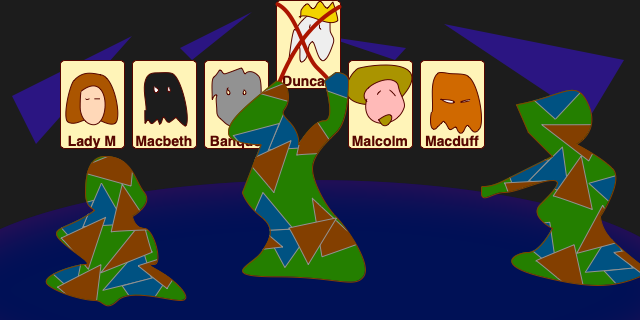
Staging the Revolution will probably require showing a Rebel Headquarters on stage in key scenes, perhaps literally underground compared with concurrent action. This HQ could feature large cards showing Duncan atop row of Malcolm, Donalbain, Macbeth, Lady Macbeth, Banquo, Macduff, perhaps Lenox, Cawdor, Rosse, Menteth, Angus, Cathness or so and such, some crossed out during play, some removed or added?

Cartoonish drawing of a gloomy cave containing three hooded figures dressed in green robes with blue and brown triangles, sitting, entering at pace and crossing off cards representing the nobles in Shakespeare's play Macbeth.
Revolution Headquarters

Class War

There are a number of indications of class war in the text. The word ‘slave’ is used as a pejorative by the lords, while lords are ‘noble’. Servants live in fear of upsetting lords. Something is brewing. Were the kerns and gallowglasses foreign freedom fighters?

Lords

Where are Macbeth’s wounds?

The wounded sergeant spins a tale of Macbeth’s toe-to-toe battlefield heroics, but this is almost immediately rendered implausible. No reference to Macbeth’s wounds are ever made (though some productions choose to show them). Indeed, Macbeth rides furiously home and his wife embraces him without comment on any hurt.

We later find that Macbeth has servants in his pay throughout the lords’ households. If we look at the over-flowery speech of the wounded sergeant, we see he falters after delivering Except they meant to bathe in reeking wounds as if he realises he has over-delivered on his tale.

Lords lie, use flowery-serpent courtesy.

Malcolm

Malcolm delivers the most devastating critique of hereditary monarchy, so much that Macduff has difficulty processing it.

Cowardice not valour is the norm

Shakespeare mocks the lords’ pretensions to valour, not just in Macbeth (who needs promise of a charmed life to enkindle him, and sends others to do his dirty work) but in his enemies like Macduff, who flees his home and family. We may suspect that common soldiers win the lords’ battle for them (Duncan conspicuously sits out battle). Not all lords are cowards, though, especially if young and seeking martial glory like Siward's son.

Superstition

A weakness of the lords’ position as a ruling class is its irrationality, so perhaps no wonder they turn to superstition. And yet dispense with it when it doesn’t suit (Macbeth: 'Twas a rough night.)

Commoners

Commoners sometimes mock courtly speech. Only a small minority will be professional revolutionaries, hence their indirect approach. Many commoners will be employed directly (or indirectly, double-paid as spies) by lords. Some are apparently desperate or vicious enough to volunteer to murder children.

Act 1

Scene 1

A meeting and rehearsal of witchy roles.

Scene 2

The ‘bloody man’ (a sergeant) contrasts with apparently unscathed Macbeth and Banquo. His testimony is flowery, therefore either created by lords for lords and rehearsed, or improvised possibly to set up power struggle. The testimonies credit only lords with victories, a second thaneship is merely a prize, not an additional onerous administrative duty.

At the mention of greeting Macbeth with Thane of Cawdor title, a revolutionary runner sets off to tip off Revolution HQ and witch revolutionaries.

Scene 3

Witches improvise (and may be overheard on heath at distance) waiting for Macbeth and Banquo. A revolutionary runner whispers in their ears. The witches’ greeting now improvised with the Thane of Cawdor news. The Revolution are at times literally underground, or camouflaged. Insane root mention may give witches ideas for later meeting.

Scene 4

Nepotism rules.

Scene 5

Attendant may overhear “metaphysical aid”, revolutionary servants may overhear Lady Macbeth, and Macbeth. look like the innocent flower, but be the serpent under it

Scene 6

Lady Macbeth not sharing praise for hostess duties.

Scene 7

‘divers servants’ may be well placed to overhear.

Act 2

Scene 1

Servants placed to overhear, to project image of dagger.

Scene 2

Servants could produce the noises and voices.

Scene 3

Suggestions that Revolutionaries have been behind some of the night’s omens to put the wind up the lords.

Malcolm: There’s daggers in men’s smiles: the near in blood, the nearer bloody.

Scene 4

Old Man (possible Revolutionary) makes references to lowly birds of prey attacking mighty and internecine horse conflict, feeding lords’ unease.

Act 3

Scene 1

Macbeth: Masking the business from the common eye Royalty is not only private government, but murderous and deceitful.

Interestingly the Murderers do not directly agree to kill Fleance, something that a Revolution might consider sadly necessary for all claimants.

Scene 2

Again, servants could overhear Macbeths.

Macbeth lists treason’s tools: steel, poison, malice domestick, foreign levy.

Macbeth: Things, bad begun, make strong themselves by ill is royalty’s recipe. Essentially royals ride a crime wave.

Scene 3

Servant leads Banquo and Fleance, 3rd Murderer joins previous two. Only Banquo is killed by 1st Murderer. Did Servant and 3rd Murderer collude in letting Fleance escape? Is the Revolution reluctant to kill children?

Scene 4

1st Murderer reports Banquo’s killing and Fleance’s escape to Macbeth as Revolution stages a daring set-piece, the Macbeths’ own servants contriving the appearance (only to Macbeth) of the likeness of Banquo’s supposed ghost. No connection between Macbeth and 3rd Murderer is made.

Angles at the table should make it appear from Macbeth’s end that the opposite seat is taken but not from angles to each side.

The back of a servant’s headdress might give the illusion of a bloodied face some distance behind, whilst another servant has placed a cloth over the chair. The illusion should disappear as Lady Macbeth draws close to her husband’s view angle.

Reappears, disappears as obviously designed, marked, rehearsed, reacting to any changes in sightlines.

Macbeth reveals he has a paid servant as his agent and eyes in every Lord’s house, so why not the Revolution a true believer in each too? Maybe the same servant even.

Scene 5

Does Hecate represent a disgruntled self-styled leader or vanguard of the Revolution? Is this stylised magical cant put on to confuse royalist infiltrators?

Hecate: And you all know, security Is mortal’s chiefest enemy.

Scene 6

The Scottish lords appear too weak to move against an apparent regicide and tyrant, one meaning of Lenox’s Things have been strangely borne

Act 4

Scene 1

Witches prepare for, and be overheard by, Macbeth.

2nd Witch By the pricking of my thumbs, something wicked this way comes is crying out to be hammily overdone and cackle-ended, inviting rolling eyes from other witches.

Revolutionaries have practised their special effects, probably throw a bit of insane root into the cauldron, and researched Macbeth’s fears, MacDuff’s birth and Dunsinane’s approaches. Ingredients may obviously be unlike their labels or incongruously packaged. The Revolutionaries plan to stir Macbeth into further outrages against lords to bring about internecine conflict. Which works.

Scene 2

Lady Macduff calls her husband’s flight unnatural and a mother wren decidedly more valorous.

He wants the natural touch: for the poor wren, The most diminutive of birds, will fight, Her young ones in her nest, against the owl.

The messenger who brings warning could be a revolutionary, but one who breaks with or keeps policy?

Scene 3

Revolutionaries will follow to the English court but keep quiet during scene. Have they, not just Macbeth, tried to work on Malcolm?

Malcolm may be testing Macduff, but is also laying bare the true nature of kingship. For example:

Malcolm: I grant him bloody, luxurious, avaricious, false, deceitful, sudden, malicious, smacking of every sin that has a name but claims he will be much worse still. The silently-watching Revolutionaries may nod in agreement.

Lenox: Would create soldiers, make our women fight this is essentially the Revolutionary plan, although to the end of removing the last lords standing.

Act 5

Scene 1

The waiting gentlewoman and doctor of physick well know that the crimes of their masters are dangerous to report on.

Doctor: Foul whisperings are abroad presumably some spread by Revolution.

Scene 2

It seems that the Revolutionaries have chosen Dunsinane for Macbeth’s downfall and planned for a host to travel through Birnam Wood, but have they miscalculated on English power? They seem to need foreign aid since Macbeth appears to have admirers even now of his 'valiant fury'. This is the problem with people who expect one monarch or another to rule over them.

Scene 3

It is a bit late for Macbeth to worry about the health of Scotland, having long had what his wife once called the sickness that should attend power.

Scene 4

Clearly, Revolutionaries amongst the soldiery are already prompting Malcolm’s order to camouflage themselves with branches. Like a Lord he wants to take all credit, of course.

Scene 5

The cry of women signify Lady Macbeth’s death. For good measure, the Messenger should be a Revolutionary to describe a moving wood rather than camouflaged troops.

Scene 6

Revolutionaries in Army are surely in contact with those in Dunsinane and are aware their ruse has worked.

Scene 7

Macbeth is now trapped and cannot fly, emerging onto plain before castle.

Macduff expresses pity: I cannot strike at wretched kernes, whose arms are hir’d to bear their staves

Maybe one of the witches was Macduff’s mother’s midwife?

Again Macbeth is exposed as a coward, relying on charmed protection, but fears humiliation by Malcolm and the rabble’s curse, although probably hasn’t realised that the rabble’s curse has brought him down already.

Malcolm is crowned king after Macduff kills Macbeth, and horror of horror, creates new earls.

Failure of the Revolution to Establish Popular Government

So, on this interpretation, where did the Revolution go wrong? Did they underestimate the Lords’ hydra-like ability to spawn new Lords to replace those killed in this engineered conflict? Or are they waiting until the English are gone? Do they have a narrative to compete with Malcolm’s? What exactly were the witches’ motives? Were the witches pagans, and was the Revolution also against Christianity, or perhaps religious differences split and weakened it? Do the Revolutionaries start wearing identical blue-brown-green triangle-patterned clothing, and end up in separate blue, brown and green factions, each represented by a different witch? The customary division of witches into Maid, Mother and Crone may help here.

Conclusion

The witches may make more sense in the context of the play, Macbeth, as revolutionaries rather than as supernatural beings. They do not possess more knowledge than could be gathered by eavesdroppers and relayed by messengers. Their acts are performances tried out on Macbeth and briefly Banquo. Certain aspects of the play make more sense as part of an orchestrated internecine plot by republican commoners against corrupt lords. Shakespeare’s play Macbeth can be staged as a popular uprising without changing any text, with the addition of some extras like dumbshow and stage directions for the revolutionary faction.

Creative Commons Licence
How to stage Shakespeare’s Macbeth as a popular uprising by Sleeping Dog is licensed under a Creative Commons Attribution 4.0 International License.

Tuesday, 24 November 2020

Enter Cordelia, disguised as Fool

Abstract

In William Shakespeare’s tragedy King Lear, there are significant textual, logical and dramatic reasons to suspect that the role of the Fool was at one point in the play’s history written to be played in disguise by Cordelia, Lear’s youngest daughter.

Nevertheless, the surviving text of the play I will refer to does not state in directions or dialogue that Cordelia is the Fool, in disguise.

Introduction

Shakespeare’s comedic daughters customarily disobey or try to circumvent their fathers, and this also applies to some of his tragic daughters, such as Desdemona and Juliet (Ophelia obeys, but shares their fate anyway, albeit diminished).

It is also common for Shakespeare’s dramatic daughters to don disguises, often male.

Therefore there is little reason to object to the possibility of Cordelia disguising herself as the Fool on the basis of the other plays. We can also discount the rather pompous patriarchal assertion that Cordelia would simply obey her father’s order of banishment because she is allegedly the model of a ‘good’ daughter: she may be, but obedience is not part of that package for Shakespeare.

Role Morality

This takes us onto to what seems to me the heart of King Lear. Lear is faced with a tragic dilemma of the conflicts raised by trying to be both a good ruler and a good parent. I say ruler rather than king as he abdicates rule but not the title; and parent rather than father since Mrs Lear is missing presumed dead (“thy mother’s tomb”).

And the play continues to examine the morality inherent in other roles, such as counsellor, overlord, wife, servant and especially offspring. The major dramatic contrast is between the characters of Cordelia and Lear’s other daughters, Regan and Goneril.

Do not assume that these role-players fall simply into social clichés: at one point a loyal servant stabs a Duke, and great trials and reverses await some of our characters.

Overview of plot, with Cordelia disguised as Fool

Act 1

Old King Lear is faced with a major problem. He would like to retire, but two of his three daughters (Regan and Goneril, each married to a duke) would each try and seize the kingdom. A ruthless King might just have the two of them killed to spare his kingdom civil war, but as a father he cannot countenance that. Lear would prefer his beloved unmarried youngest daughter to inherit, but the other two would gang up on her first. Perhaps the only way he sees (possibly unconsciously, he has “slenderly ever known himself”) to guarantee her safety is to engineer a falling out then a love test with the two suitors to see where she may be safely bestowed while the other two daughters duke it out. The King of France graciously accepts dowerless, disinherited Cordelia for wife, and Lear contrives to banish loyal Kent, possibly in order that he accompanies Cordelia to the French court as protector.

Painted sketch of Britain with Goneril's Albany faction in the North, Regan's Cornwall faction in the Southwest, and Cordelia about to be driven away from Kent in the Southeast.
Lear's Britain, to be divided in three for his daughters

So, a fake love test of words followed by a real love test of deeds, all for Cordelia's benefit. Does anyone really believe Lear when he says his aim is that:

“future strife
May be prevented now”

We only have disowned Cordelia’s immediate reaction, and then she disappears from the play until the closing stages. Or does she? At any rate, we have to imagine an unplayed scene with Cordelia and the French King where she lays her plans and demands upon him to provide her with support that later appears in a French army landed at Dover to back her claim. She might as well have a more direct involvement in mind, and a much greater desire to stay with her father in his hour of greatest need than the King of France to which she shows no affection.

Kent ignores his King’s order of banishment and disguises himself as a rough servant we much later discover is named Caius, in order to reenlist in Lear’s service to look after him. There is a stage direction (Act 1 scene 4) “Enter KENT, disguised” and a short speech where Kent explains his disguise. The Fool first appears in the same scene.

In the text, the Fool is introduced as “Enter Fool“ not “Enter Cordelia, disguised as a Fool”. Neither does Cordelia give a speech explaining her disguise. However, these may have been removed from the text at some point, or Cordelia’s disguise may have been treated differently. Anyway, the Fool goes straight to Kent-Caius, which may indicate recognition, immediately penetrating Kent's disguise. From now on, I’ll refer to the character as Cordelia-Fool.

There is a telling introduction where Lear has missed the Fool since exactly the time of Cordelia’s departure, two days in which Cordelia-Fool has arranged for the real Fool to go into hiding, arranged her plots with her betrothed French King, and adopted and practised her new disguise in the same time period as Kent has. But Kent does not recognise Cordelia-Fool in return, who seems to immediately take the opportunity to test her disguise.

Cordelia-Fool plays constantly on the theme of daughters, and repeatedly utters the sentiments of Cordelia. When Cordelia-Fool says Lear has banished two of his daughters and given the third a blessing against his will, she is thankful. When Cordelia-Fool says:

“I marvel what kin thou and thy daughters are:
they'll have me whipped for speaking true, thou'lt
have me whipped for lying; and sometimes I am
whipped for holding my peace.”

this can only relate to the previous exchanges between Regan and Goneril and Cordelia; and between Lear and Cordelia. Cordelia is rebuked and punished (not literally whipped) for all these cases. Cordelia-Fool also echoes and throws back Lear’s nothing-can-come-from-nothing phrase. Lear notes the Fool’s behaviour has changed, more singing etc.

In his reactions to Kent-Caius and Cordelia-Fool, Lear demonstrates how he “acts on instinct” (as Falstaff feebly claimed in Henry IV), or rather operates partly on an unconscious level, treating these two as affectionately and trustingly as if he knew them. This is of a piece with his repression of fatherly instincts in order to rule as king.

The number of occasions where Lear says ‘daughter’ when Cordelia-Fool is present also allows acted reaction.

Act 2

When Lear starts to express his worries about going mad, we are left wondering if the appearance in his coterie of Kent-Caius and Cordelia-Fool is not helping his sanity. Indeed, while conversing with Cordelia-Fool he says suddenly “I did her wrong”. Small wonder the Fool reminds him of Cordelia. Lear addresses the Fool as ‘boy’ so it makes sense that Cordelia could pass more easily as a youth.

Anyway, the plot develops, and Kent-Caius has mysteriously come into possession of a letter addressed to him from Cordelia (Act 2 scene 2):

“I may
Peruse this letter! Nothing almost sees miracles
But misery: I know 'tis from Cordelia,
Who hath most fortunately been inform'd
Of my obscured course”

No mystery mate, that’s her in the Fool’s outfit, the only reasonable way she could have discovered his disguised presence in the King’s company and slipped the letter to him, with speed that strongly indicates she cannot be in France as her cover story implies.

Act 3

The plot drives onwards, and the Fool refuses to part with Lear when everyone else has.

Kent-Caius: “But who is with him?”
Gentleman: “None but the fool; who labours to out-jest
His heart-struck injuries.”

When Lear says:

“Poor fool and knave, I have one part in my heart
That's sorry yet for thee.”

this maps on to Lear's division of his kingdom into parts (then depriving Cordelia of hers).

When Lear’s remnants encounter poor Tom in a hovel during the storm, it is Cordelia-Fool who is disturbed by his near-nakedness, providing a comic moment in otherwise dire times:

“Nay, he reserved a blanket, else we had been all shamed.”

and is the one disturbed by (her father) Lear’s subsequent disrobing.

Again, Lear's address to the Fool:

“In, boy; go first. You houseless poverty,”

only really makes sense in relation to Lear's having made Cordelia houseless and poor.

The Fool's last speech is in answer to Lear's finally going to rest, talking about supper in the morning.

Cordelia-Fool: “And I'll go to bed at noon.”

which is to say, Cordelia-Fool plans to travel all night to Dover, where the litter arranged by her with the King's loyal knights is to convey Lear, which is immediately discovered by allies Gloster and Kent.

Act 4

Anyway, the Fool disappears sometime before Lear is united with Cordelia and Kent. Cordelia is mentioned receiving letters in the French camp in Act 4 scene 3, when the King of France deserts the campaign in Dover. We see her briefly in the next scene looking forward to a reunion with her father Lear.

Cordelia’s soldiers seem to be directed to Lear, which is unsurprising if Cordelia-Fool has recently left his company. It is not until Act 4 scene 7 that Cordelia and Kent (still apparently in disguise but openly recognised by Cordelia) are formally reunited with Lear. Cordelia seems very accurately informed of Lear’s ordeal in the storm, again unsurprising if she was present. When Lear says to Cordelia:

“Methinks I should know you, and know this man;”

this makes sense in the context that he last saw both in disguise.

Act 5

In the last scene, after Cordelia is hanged in prison and Lear carries her out, after various laments and Kent telling Lear he had posed as his servant Caius, Lear exclaims:

“And my poor fool is hang’d!”

which of course could be a plain and simple recognition of Cordelia-Fool.

Thematic Support

The play revolves around people not being as they seem. Regan and Goneril pretend to be loving daughters, Edmund pretends to be a loyal son and half-brother. Their fathers Lear and Gloucester appear to be deceived. Cordelia and Kent’s plain words anger Lear, but their actions are of love and loyalty even as they disobey, as are Edgar’s to his blind father even as his words deceive and he disobey’s his father’s instructions to assist his suicide. So there is a distinction between being literally honest and being true. Kent deceives and disobeys but truly serves his King. Cordelia could quite consistently do the same. The play’s heroes do not abandon their loved ones at time of greatest need, in spite of being disowned by them.

Another other aspect is that Lear, caught in irreconcilable conflict between being a good King and a good father, fails at both, and this is a point that Shakespeare rams home as one of his searing indictments against the institution of hereditary monarchy. By repressing his parental/paternal care, it is left to work subconsciously, but he also neglects his own kingdom, as he belatedly recognises too. Lear’s anguish at his treatment from Regan and Goneril seems to stem from his repressed fatherly love that at some level he is shocked is not requited, although his eldest daughters may have been starved of the affection he seems in his later years to have bestowed on Cordelia. Lear’s close relationship with Cordelia-Fool therefore works off this subconscious recognition, as his regard for Kent does for Kent-Caius.

Also, Cordelia and Kent are aware that old Lear’s eyesight is not that sharp and he has begun to mistrust his senses. There is a constant theme of one’s senses being at odds: one’s nose may descry what eyes and ears are fooled by (and Cordelia-Fool’s close proximity to Lear seems to have an effect, and the sense of smell is closest to memory).

On Tragedy

If Cordelia is to rank alongside the other tragic figures in the play, she has to make a fateful choice, like Lear, Kent, Gloucester, Edgar, Albany, even Cornwall’s unnamed servant-executioner. The only space in the play for her to make such a choice is to refuse to accept banishment, and stay beside her father in the time of his greatest need, in the diguise forced by necessity. On the framing of the play, it is clear that Cordelia does rank with those others, her death is more significant than any other in the plot (if Cordelia survives, there is no tragedy). We do not see her making any such choice, unless it is as Cordelia-Fool.

On Comic Relief

Some people have historically seen King Lear as an unremittingly bleak play. Yet with Cordelia-Fool in play, there are a number of comic notes and touching elements that relate to Lear not being abandoned by his beloved daughter Cordelia, who charges the Fool’s lines with new pathos and meaning.

Conclusion

Or rather inconclusion. There are elements of the text and dramatic logic that strongly support the notion that Cordelia was at some point in the development of the play disguised as the Fool character. Historically, if the characters were doubled and the same actor played both in the early productions, there is at least no dramatic obstacle for the unity of the two characters, which are never on stage at the same time. However, Cordelia makes no direct acknowledgement of this role in the text, nor do the stage directions support the idea of Cordelia-Fool.

The play’s natural tripod cannot be sustained by Kent, Edgar and a missing leg of Cordelia.

A modern staging of the play could support the unity of the Cordelia-Fool character with dumbshow and the like without altering the text at all, and perhaps make better sense of the tragedy of King Lear. Which is that to be true in one’s role morality to another, may sometimes require subterfuge, and is not the same as plain honesty.

Painted sketch divided down middle between half-portait of Cordelia on the left, and half-portrait of Fool on the right.
Cordelia-Fool

Enter Cordelia, disguised as Fool by Sleeping Dog is licensed under CC BY 4.0