Showing posts with label commons. Show all posts

Tuesday, 5 March 2024

The Sea-People’s Citizen Assembly Scenario: Democracy 0 – Biocracy 1

Abstract

A thought experiment to test democracy in a non-human scenario.

Introduction

Popular fiction often depicts sea-people as ruled by monarchs (Disney, Marvel, DC Comics) but suppose that our fictional sea-people have the very best form of democracy you can imagine. This could involve citizen assemblies, mandatable recallable delegates, anything you consider to be best practice.

Five various sea-people sitting around a conference table among distant other tables in an undersea chamber
The Sea-People's Citizen Assembly, diversity champions, hard at work

Now imagine a scenario whereby, perhaps in retaliation to land-people dumping waste in the sea, the global sea-people community democratically decide to dump some of their waste on land. This leads to friction, leads to war, all with ideal democratic processes followed perfectly by our sea-people, leads to annihilation of land-people civilization and many living species by weapons of mass destruction.

If you consider this a bad outcome, from an ideal form of democracy, what is wrong in this scenario? Is the problem the extension of democracy to non-humans, even if they are in many ways very similar to us? Or are there any flaws in democracy you can identify?

The Sea-People’s Citizen Assembly Scenario: Democracy 0 – Biocracy 1 by Sleeping Dog is licensed under CC BY 4.0

Thursday, 19 May 2022

Constitutionally-encoded Biocracy

An enquiry into what form of government we all need today. It's this one.

Abstract

Perhaps the only sane form of government today is a constitutionally-encoded biocracy. Why? Here are some key features.

Introduction

Our planet Earth faces climate change, environmental degradation and pollution, mass extinctions… I will not dwell on the current and future threats, or the failures of current political-economic-ideological systems in countering them. Biocratic government is not simply a necessary response to emergencies, it is a necessary precaution against future emergencies. Specifically: a formal codified constitutional model of biocracy, where proxies representing the living world have a majority in political decision-making, and the global idea communism of life sciences provide the most objective measure available of the health of ecosystems. That is, biocracy may be necessary for survival, of human society at least.

So, human Parliaments today mostly serve humans, and really only a few of those, and not particularly well, considering. This is pretty messed up, when you think about. Much damage is being done to the non-human world by humans. Therefore, one solution is to add majority-sized blocks of representatives for the non-human world, to make sure better decisions are made. For all of us.

And we need a new word for this combination of human democracy and green authority: call it, biocracy.

—Sleeping Dog, The Lorax Amendment: Retro-fitting Green Authoritarianism to Parliaments
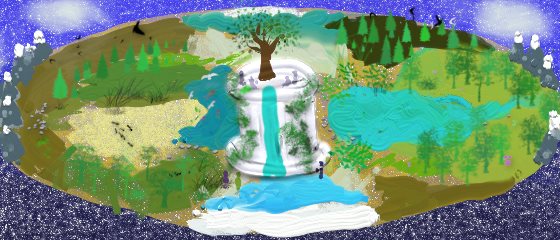
A painting of a healthy world, with good things flowing from a central pillar on which stands a mighty tree.
A biocratic world is a healthy world

The argument for biocracy rests upon the proposition that a viable future depends upon adherence to the basic principles derived from the life sciences, as mediated by human values, and tested for their real-life consequences.

A precept of biocracy is the need to understand the factors that make for the survival of peoples, their societies, and their cultures.

A basic bioethical assumption is that, in principle, life is good.

A basic tenet of biocracy is that prospects for human well-being and survival depend upon the validity of popular attitudes toward living nature, especially human nature.

—Lynton K. Caldwell, various quotes from Biocracy: Public policy and the life sciences

What follows is a sketch, not a blueprint. An outline of a model derived from principles grounded in nature. A seed, if you like.

Some biocratic principles

If you don't like these, there are others:

  • life is a good thing, on the whole
  • we must respect the primacy of nonhuman life (that is, human life depends on non-human life, but not vice versa)
  • we should preserve the environment for present and future generations (of non-human and human life)
  • environment as universal heritage (more of a humanist principle)
  • applications of the precautionary principle
  • nature must be a subject in law, not an object
  • non-regression in legislation, standards, policy and practice: don't make things worse, apply highest levels of environmental protection

Concepts from life sciences

First of all, what are included in 'life sciences'? There are many basic and applied life sciences at different levels of specialism and with different focuses, for example biology, ecology, human medicine, botany and so on (and I would include psychology).

Welcome to the Great Hall, designed to represent the Earth's biosphere. That is, the envelope around our planet that supports life, in the seas, on land, in the air, and so on. Each main building complex represents one of Earth's biomes, such as grasslands, tundra, desert, freshwater and marine, and the various forest types. Our human architects have invited in some of nature's own architects, and you will encounter some of their constructions on our tour.

On display are artworks created by children from around the world, on some part of nature meaningful to them. Those marked thus, represent species now thought to be extinct.

—A 21st Century (Common Era) biocracy tour guide

Far from a clockwork universe, life sciences describe complex, adaptive systems with emergent behaviour (of which life itself is one example), capable of regulating states (as in homeostasis), but also experiencing cycles (like seasons) and phase changes. Understanding these allows humans not merely to survive, but to live a good life.

Good life philosophy

It is reasonable to suppose that a biocratic constitution will make reference to one or more good life philosophies, perhaps Sumak kawsay / Buen vivir, ubuntu, or Eudaimonia. These are about living (ethically) well, not having fun. The most suitable philosophies will contain ecocentric rather than anthropocentric worldviews.

In general, the Constitution will prescribe planetary-realistic ideologies for public policy.

Open government

Transparency is essential in the conduct of biocratic government. There is no need for hidden diplomacy, no channels for lobbyists for vested interests, no belligerence, no empire-building. The fundamental position is idea communism: open science, open technology, and the global digital commons.

Distributed authority

Distributed authority is one of key benefits of constitutionally-encoded biocracy. Instead of authority being centralised and claimed by a human elite (possibly on behalf of supernatural beings), authority can be spread beyond national boundaries, to any human individual or group capable of bearing witness, any method of objectively telling the health of ecosystems, and to non-human life. Who or what can tell us how well we are governing and living? All of the above.

Even anarchist Michael Bakunin recognized the authority of natural laws. Yes, you could say that our biocracy is technically an anarchy because we have eliminated the whole human political ruling class. But yes, we have laws, we have order. And in this order, Nature places above Humans, and Humans above Economy.

Nature is our ultimate authority, the great scorekeeper, as we say.

And when it comes to collective decision-making, it is best we recognise that political decisions come in all sorts and sizes and urgencies, and therefore are best handled in separate ways (some technocratic, some democratic, some biocratic, and so on). The design of our biocratic constitution was somewhat concerned with decision categorisation, delegation, prioritisation, integration, 'single source of truth', logjam avoidance, joined-up governance and so on.

Yes, this means that after the construction of our Constitution we have largely relegated full-scale democracy to a lower division, so to speak, but it still plays a number of important roles.

—A 21st Century (Common Era) biocracy tour guide

Health of ecosystems

Only life sciences have objective methods of determining the health of ecosystems. For example, the ecosystem health of a coral reef might be measured by proxies such as counting manta rays or the percentage of seasonal coral dieback. In a similar fashion, medics may take a human's temperature and count their pulse-rate. There will be some differing opinion, but a great deal of consensus, and questions are likely to be resolved by further research. The point here is rather that biocratic policies and interventions can be tested in the field.

Regenerative economies

You can find a 1.5-minute animated video by Kate Raworth on regenerative economics which gets the point across (and will be the only kind of lawful economy under a constitutionally-encoded biocracy).

In biocracy there is no right to impair health of consumers or degrade public health. It would be logical to nationalise or internationalise life science industries (pharmaceuticals and other medicine related to public health; open-source agriculture etc.)

Rights of Nature (legalism) is not enough…

…but such a framing will be required in our Biocratic Constitution. The concentric circles of the Rights of Nature Model indicates the hierarchy Nature above People above Economy. Current environmental law is dysfunctional, ecologically illiterate and unstrategic.

This necessary step will involve the legal recognition of the Rights of Nature on all levels and a shift from a purely anthropocentric worldview to a more ecocentric worldview that sees humanity as one species within a radically interconnected web of life, where the wellbeing of each part is dependent on the wellbeing of the Earth system as a whole.

—Michele Carducci, Silvia Bagni, Vincenzo Lorubbio, Elisabetta Musarò (UniSalento-CEDEUAM) Massimiliano Montini, Alessandra Barreca, Costanza Di Francesco Maesa (UniSiena) Mumta Ito, Lindsey Spinks, Paul Powlesland (Nature's Rights), Towards an EU Charter of the Fundamental Rights of Nature

With a constitutional provision, laws inconsistent with biologically-established fact could be struck down (abortion, tobacco).

Over on our right, the central Courts of Justice are trying some ecocide cases today. Ecocide is a class of crimes that legalises any reasonable means of stopping them; in fact, in this jurisdiction, people are obliged to at once, at minimum informing the authorities. Perpetrators and planners of ecocide are automatically outlawed, with all legal protections withdrawn. There are no legal defences or mitigations, as expressly stated in our Constitution.

Lesser environmental crimes are prosecuted on a similar basis in local courts.

—A 21st Century (Common Era) biocracy tour guide

However, much more is needed than a legalist solution of precautionary and reactionary enforcement. A full political system with roles and responsibilities in research, planning, testing, tax-raising powers, diplomatic service, strategists, administration, education, food security, sustainable living standards, conflict resolution and so forth is required.

It would be necessary to establish publically funded institutions to represent the interests of nature and new courts or other institutions with the sufficient knowledge and understanding to adjudicate conflicts between economic development and nature in order to promote the greater good of the whole community.

—Jan Darpö, Can Nature Get It Right? A Study on Rights of Nature in the European Context

Global responsibility

There is a war being conducted against nature, although only one nation has so far declared it.

Old-fashioned political nationalism has become one of the principal obstacles to biological sanity.

—Lynton K. Caldwell, Biocracy: Public policy and the life sciences

One elemental responsibility that was hardly mentioned enough in the COVID-19 pandemic was that national borders should be closed to prevent the disease pathogen escaping from each nation (not just entering). Each nation is responsible to all others for global public health, and biocratic constitutions will make this a formal provision, whatever international treaties say, or do not say. We get our core ethics from our biology as a species of social animal, one might say a political animal.

Ongoing research into, and improvement of, human politics

In a rational society, greater effort would be put into scientific study of human nature and environmental relations. This would involve collective self-reflection on human politics (why there are problems of corruption, nepotism, dynasties, power relations) and ongoing research on it.

Human psychology is both the problem and solution. Our power structures elevate psychopaths, the corrupt and the unfit for office; our imperial education system trains and conditions them; our exploitative/extractive economy rewards them; and our humano-centric legal system protects them; our militarism turns them into mass murderers; our established religions absolve them; and our corporate-state poets write hymns of praise to them. We need to apply our knowledge of human psychology and neuroplasticity to grow towards a life-sustaining political system which takes the lead from the non-human natural world, if we are going to survive. I call such a system biocracy, and is the only radical solution that substantially addresses the points of this article that I am aware of.

—Sleeping Dog

Research has shown how children who have had adverse experiences or are detached from nature can show reduced empathy for the natural world, but equally environments where children connect with nature have a wide range of benefits, including a more ecocentric view of politics.

After our biocratic constitution was democratically constructed and chosen, democracy took a step back and down. Now that our democratic processes no longer deal with life and death issues, the popular will was that default voting age should be lowered to enfranchise schoolchildren. Our schools are now nurseries of democracy, and we expect great things as a result. However, some qualifications on democratic participation were considered appropriate; some collective decision processes have higher age restrictions, some require participation in consultation processes, others by local residence, and some are weighted according to other pertinent qualifications.

Yes, we are aware of the many negative historical examples of disenfranchisement, and are confident we will not repeat them out of ignorance. But ask yourselves if sometimes there was too much enfranchisement, of senile people perhaps. That is a question currently under review here, and extensive research has already been done. We do keep all these rules under review, and again I remind you of our belief that not all decisions are the same; perhaps we are simply a bit more honest about that than in other countries?

—A 21st Century (Common Era) biocracy tour guide

Discipline

As Caldwell writes, open democracies are adaptable but undisciplined. We continually face problems with biotechnology and invasive species.

To believe that the international flow of biotechnology is free from political manipulation, commercial self-interest, ethnic suspicion, and religious opposition would be naive.

—Lynton K. Caldwell, Biocracy: Public policy and the life sciences

Where Caldwell falls short is in taking this to the logical conclusion and building model of a new form of government from a biocratic ideology, because at the time the world was apparently not ready for such a radical move. Well, if not now, when? We can develop a political system that eliminates the ruling class, and personal riches, and leave people with enough for the good life, particularly with communal and digital wealth. But there will need to be a public acceptance of some green austerity borne by all. Like Epicurus, we might learn to be happy with bread and cheese shared leisurely with friends. But many aspects of life will need to be quickly tailored to fit inside planetary boundaries, and that will require discipline, not indulgence. Luxuries will be small ones, footprint-wise.

Our old system of environmental law was weak, disintegrated, largely incoherent, and had a traditional fixation on private property and suing for personal damages. Someone once likened it to a robot babysitter, faced with a child in its care playing with matches, looking through its set of rules and saying: "Please put them back in the box when you have finished." No wonder our house was on fire!

There were so many problems with militarism, biotechnology and invasive species; with democracy and public behaviour; and yes with science itself which is corruptible, sometimes driven by faulty ideology or ego, sometimes irresponsibly and callously carried out. And sometimes put to criminal uses.

The solution was to make everyone, to some extent, a life scientist. Our lawmakers and court officials, our civil servants and professionals; every child gets a comprehensive education in life sciences. And not just in gardening or animal care or nutrition, vital though these are, but in systems thinking.

Yes, before the Age of Biocracy there were some biocratic provisions in governments, local and national, in constitutions and international treaties, that were precursors to (and often inspired) our fully-encoded biocratic constitution. Some claimed specific cultural inspiration, but really it was the common sense of ordinary people prevailing, and you can only shut out sanity for so long. And the consequences of one good example should not be underestimated. Which is why good examples are so quickly targeted for annihilation by oppressive forces. Oh, is anyone here from…?

—A 21st Century (Common Era) biocracy tour guide
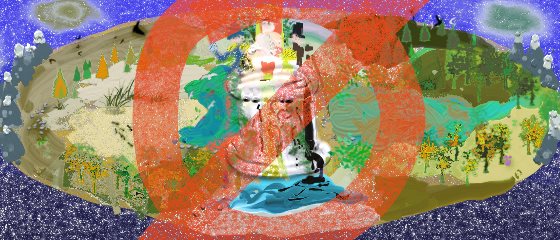
A painting of a diseased world, poisoned from a pillar in the centre, topped by authority figures.
A world governed by autocrats, militarists, undisciplined democrats, extractive capital, theocrats (and other undesirables) is an unhealthy world

Opportunity

The opportunity to set a good example in government comes all too rarely. To found a new kind of government based on constitutionally-encoded biocracy will be an option during the creation of a new state, perhaps from a successful independence movement or a unification. Never before has seizing such an opportunity been so critical to the survival of human and non-human life on our planet Earth.

Conclusion

While acknowledging this:

Science is a human artifact and provides no infallible guide to conduct or policy. It may, however, inform human choices and expose assumptions that lead to folly.

—Lynton K. Caldwell, Biocracy: Public policy and the life sciences

the other political systems we are familiar with, theocratic or humanist, are all much more fallible by design and have proved routinely corruptible and now (with weapons and economies of mass destruction) extremely dangerous. Time and again, we see the pattern in politicians and priests that begins with "What's in it for me?" And this applies to many social movements too, confusing self-interest with public interest. With one notable exception: the environmental movement, which places value in nature, and takes the long view of deep time and the survival and thriving of non-human species, ecosystems, and future generations of humans within our living world.

What is healthy government? Only one with the principles of life sciences and the good life at its heart. Choose life. Choose biocracy, now.

Biocracy Now logo
#biocracynow

Constitutionally-encoded Biocracy by Sleeping Dog is licensed under CC BY 4.0

Friday, 11 October 2019

Three Communisms that Shape Our Modern World: Global Science, Open Technology and the Digital Commons

Introduction

Ideas are the means of production of more ideas (💡+💡=💡💡💡), and this:

  • applies in science (hence Isaac Newton’s standing on the shoulders of giants),
  • applies in technology (most obviously in digital technology built of components in layers on top of standards), and
  • applies in the digital commons, where creative works bubble with the influences of others in shared and standardised languages (text and visual, say) and forms, freely available for all to use.

Each of these communisms is formed from a community of communities (👩‍🔬👨‍🔬👩‍🔬 + 👨‍🔬👩‍🔬👨‍🔬 + …) with a commons (📚📚), and a set of collectively-decided rules and conventions (📖) on how to use and run it (and proscriptions against abusing it).

These commons have long ago transcended national borders. From The Communist Manifesto by Karl Marx and Friedrich Engels (1848, Samuel Moore translation, Penguin Classics):

The intellectual creations of individual nations become common property. National one-sidedness and narrow-mindedness become more and more impossible, and from the numerous national and local literatures, there arises a world literature.

Global Science

Efforts to create a global (unrestricted by national or imperial boundary) commons of science go back further than the Encyclopédistes of the French Enlightenment or the Translation Movement of the Islamic Golden Age.

It was the European scientific commons that gave their empires an eventually-decisive edge against those empires outside it. Global science today has its biases and controversies, but is characterised by the components of the scientific method which require open publishing.

Non-communistic or privatised science gives us alchemy instead of chemistry, astrology instead of astronomy, or (ideologically speaking) Lysenkoism instead of biology.

This kind of idea-communism should tend towards logical and testable consistency, with special attention given towards anomalies.

Open (Source) Technology

The modern world not only runs on open technologies and standards, it could not exist without them. All the proprietary attempts to build the Internet failed, and the essential interoperability of digital technology is guaranteed and underpinned by open standards.

You find notable areas of this global commons such as:

  • programming languages
  • Internet stack
  • web servers, web browsers
  • maker movement
  • web and data standards

With so many attempts to 'own' common technology (often as horrifically absurd as British Telecom's claim over the hyperlink), robust legal protection is required, for example in patent control.

This kind of idea-communism should tend towards interoperability and continual improvement of ideas, with special consideration of resolving the tension between these two aims.

The Digital Commons

There are the well-known licence-smiths like Creative Commons, the content organisers like Wikimedia Foundation and the archivists of public domain like Project Gutenberg, but digital commons are spread much more widely than these examples.

Wikipedia is now something of a battleground in the various wars of ideas that spring up globally and locally, as well as a target for the enemies of idea-communism itself.

Any high-profile digital commons based in places like the USA tend to be coy about the communistic aspect of their work to avoid drawing down the ideological lightning, but I doubt it is the general publics of the Earth they have to fear.

This kind of idea-communism should tend towards diversity of content and form, and support a multiplicity of views and approaches, while fostering critical means to assess on dimensions of quality.

The Enemies of Global Commons

While corporations, states, organised ideological groups may benefit greatly from commons, their activities are often geared towards exploiting, undermining, manipulating or destroying them.

For example, Fascists and other factional authoritarians may have an ideological concept of science that is not communistic, perhaps that scientists should serve the state, possibly not contradict government policy/religious authority, and so on. Their antipathy to global science goes far beyond resentment of any particular research finding or area. They will oppose such things as globally-focused public libraries and digital commons for the same reasons: ideas are the means of production of more ideas.

Some other groups like flat-Earthers, anti-vaxxers and/or Creationists may hope to discredit the notion of public collective-decision-making, and even democracy itself. The idea of a shared, objective 'truth' outside of central/authoritarian control or overriding a preferred subjective worldview can be threatening to some, even if an actual commons reflects a plurality of worldview or beliefs.

The Dangers of Unconstrained, Partisan or Militarized Idea-Communism

With the awesome effectiveness of these global communisms of ideas comes some dangers, especially when knowledge can be weaponised. There are currently great concerns over whether DNA sequences of certain viruses should be released beyond a few researchers, since viruses can be increasingly easily be made by automated machinery.

Other risks are that an ideas community or commons becomes contaminated or manipulated by outside forces, develops its own biases, contains gaps, excludes people or ideas in way that harms the globally-beneficial intent. Nowadays, many private corporations parasitise off of the global scientific commons, and pollute it with paid-for results (suppressing research findings that interfere with profits).

And as previously mentioned, when one part of human society wields the power of an idea commons against other parts, such as happened during European national-imperial expansion, then this constitutes a threat to those who wish to live in peace.

Conclusion

Not every scientist, technologist or digital contributor is a communist. But many are part of a community of communities who contribute, run and draw from a commons of ideas and decide on its rules.

When Marx and Engels wrote "All that is solid melts into air…", they presumably did not have the digital revolution in mind, that allows their Communist Manifesto to be beamed through Wifi into your device.

However, given the revolutionary changes of the information age, and the many vast global challenges human societies face, it would be foolish a) to fail to use the greatest means at our disposal to meet these challenges, b) to fail to recognise the communistic nature of them, and c) to reject using these means because of some ideological objection to communism based on indoctrination or misunderstanding the essential nature of something which has been portrayed as a bogeyman, a Spectre to frighten children with.

Some of the most advanced privately-funded research organisations and technology corporations are joining the global community and sharing in the global commons precisely because it is the rational and responsible thing to do, and adjusting their business models accordingly. Having already profited enormously from these three great idea-communisms, it is the right thing to do in every way. Indeed, communism could become the new normal.

Creative Commons Licence
Three Communisms that Shape Our Modern World: Global Science, Open Technology and the Digital Commons by SleepingDog is licensed under a Creative Commons Attribution 4.0 International License.