Showing posts with label Doctor Who. Show all posts

Sunday, 16 March 2025

Doctor Who and the Ideal Immigrant

Abstract

The remarkable themes of Doctor Who Special: Joy to the World, briefly unpacked.

Introduction

I have previously written about the problems and lurch to the political right of the reboot of BBC television drama Doctor Who. In the 2024-12-25 Special, Joy to the World (the dire plot of which has been adequately addressed in other places), these trends continued. So, onwards, with spoilers.

Painting of a green-skinned alien in a suit dying in bed.
Death of an alien

Some old favourites

The Doctor abuses women

Not for the first time, harsh negging used by the male protagonist for a female’s (Joy's) ’own good’. Also, wouldn’t it have been kinder not to screw up the hotel-worker woman Anita's life? Coercive control and all that.

Nature Traduced

Dinosaur (and Nature) reduced to a bitey oubliette cameo.

No threat to capitalism

Even Doctor’s sworn ‘enemy’ seems to thrive while he parties around.

The waiting game

Perhaps not so extreme as the writer’s previous obsession with waiting, Joy waits on return, Anita waits for Doctor to leave.

Don’t make me think

Feels. Is ‘some people are lonely at Christmas’ really the height of insight the show aims at? Why yet another ‘Blitz’ reference that ignores the vastly larger number of people the British have bombed? Or are helping bomb right now?

That old one-way door granting strange adults access into a vulnerable young person's bedroom

Seriously, if one of these writers is your landlord, get out now! Don't stay to grab your kettle, just bolt out the front door and never come back. This is not going to work out like Monsters Inc. Anyway, I've summarised previous red flags.

Various others

Once could also add 'Kissing-up to Christians', 'Badly Misjudged Joy' (it was going around), the problem with characters, the deadening Earth-and-Human-centricness of it all…

The 'Good' Immigrant

However, what really stood out for me was the depiction of the 'Silurian' hotel manager character, killed off third-way through. Here's some of the excruciating dialogue, as we are treated to unnecessary racism as the unnamed character dies.

17:03 Doctor: You’re a Silurian, the proudest race I know.

17:10 Dying ’Silurian’: I was lost. In the caves. There was a door. This place. They were so kind. It was so exciting.

From this depiction, we can see how the writers envisage the perfect immigrant:

  1. Dehumanised: this 'Silurian' doesn't even get a name (and 'Silurian' is a misnomer, not a great term then).
  2. Is singular (absolutely no hordes).
  3. Point of entry is singular and sealed… no more to follow.
  4. Doesn't reproduce.
  5. Works in the service industry.
  6. Works in public, brightly-lit spaces with comforting security (is quite unthreatening).
  7. Wears western-style clothing.
  8. Is polite and speaks perfect English.
  9. Is pathetically grateful.
  10. Enthusiastically boosts the wonderful nation of his saviours.
  11. Disses own (mere caves, etc)
  12. Dead.
  13. And dies in the most convenient, tidy and least consequential way imaginable, without imposing any obligations at all (nobody even needs to email their next of kin or whatever).
  14. Quickly forgotten.

Now, I don't have to explain why this panders towards far-right, xenophobic tendencies, but combined with the Doctor's emoting does suggest how foke Doctor Who is these days. Has Modern Who been captured by the far right, is this BBC-core or pragmatic pandering to retain its licence fee?

Friday, 2 February 2024

Why did the 2023 Doctor Who Specials embrace far-right tropes on immigrants, foreigners and ethnic minorities?

Abstract

Four special editions of BBC's Doctor Who primetime 'Adventures in Time and Space Drama' broadcast in 2023 exhibit far-right tropes, so what are these, and why?

Introduction

First we will set the scene regarding the direction the rebooted Doctor Who has been moving in.

Then we will take each of the Specials in turn to pick out specific and common tropes, include some feedback from right-wing press reviewers, present our conclusions and speculate as to motives.

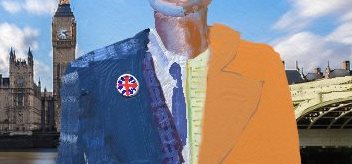
Top jackets of 14th and 15th Doctor Who with Union Jack badge in front of British House of Commons with Big Ben clock tower.
"Doctor Whos, defenders of London, home of the BBC, the Centre of the Universe"

And yes, of necessity there will be spoilers. Before we start, a brief note.

Art develops at scale

Or: more patterns emerge as a body of work grows. Stereotypes or typical traits emerge more clearly over a body of work. Silences, avoidances, distortions, favourites are easier to spot when the opus of a creator (or a country's creative industry) is considered, than in a single work. The forest emerges from the trees. So, we consider that the repetition of consistent themes in four Specials is a much more significant pattern than themes in one or two out of four.

The Direction of Travel

We have already analysed the Doctor Who reboot up until the The Return of Doctor Mysterio (2016), which provides us with some starting themes.

Londocentrism

Instead of the BBC's own pitch of Adventures in Time and Space, we get larks in London and Cardiff (and Sheffield).

Individual-Over-the-Collective

Since the reboot, Modern Who embodies the rightwing Great Man (Occasionally Woman) View of History (reminiscent of the BBC's own star system?) while Classic Who typically tried to avoid it (the Classic Doctor started off as a researcher with a malfunctioning TARDIS, and was not the locus of problem-solving). However, even more extreme valuation of select individuals have arrived with the trend towards ego-dominance politics of Modern Who.

Appearances

There is a highly regressive feel about Modern Who's preoccupation with superficiality and the perceived outward attractiveness of characters, which leans towards speciesism and a narrowing of focus.

Monsters and Terrorists

Aliens are now typically monsters or terrorists, to be defeated or killed, preferably both.

No Such Thing as Society

In all the broadcast reboot, there is no alien society fairly sketched.

Child endangerment

Red flags, combined with the celebrity-importing and sexualised themes and styles.

The Star Beast

The plot of the Star Beast is essentially Donald Trump's anti-immigrant version of The Snake

claiming that the decision to allow people claiming refugee status to enter the United States would "come back to bite us", as happened to the woman who took in the snake in the song.

Now, appearances-can-be-deceptive is by itself a useful instruction, albeit one the appearance-obsessed Modern Who applies selectively. But because of the show's current Anglocentrism, aliens are mostly shown as visitors, and here an actual asylum-seeker, the Meep, who turns out to be a mass-murdering fugitive from justice.

Donna: “I would burn down the world for you” (09:39). Well, the Doctor previously would have destroyed the Universe for Clara, so perhaps this counts as progress. As in the small-minded focus on Donna’s ‘terrible price’ (she forgets the Doctor and adventures), the rightwing Self-Over-the-Collective trope manifests in various ways throughout these specials.

I was left wondering if a BBC drama about London firefighters tried to make the main characters sympathetic by having them dither over whether to tackle a city-threatening blaze or nip round to see if their own house was OK, what the viewer reaction might be. Nobody seemed all that fussed about some distant civilization or galactic council being obliterated or eaten, and even the Doctor's apology expression of regret for getting the bumbling galactic cops murdered by an entity in his own custody seemed merely for form.

Wild Blue Yonder

Wild Blue Yonder is a war song, but a USAmerican not a British one. Why the distancing?

The aliens use terror to make copying easier. Replacement is one of the far-right’s concerns, but perhaps that is just a coincidence here, and is more like Capgras syndrome, or just identity theft.

No alien/foreign society yet again. Instead a laserlike small-minded focus on characters, yet again, as with celebritising history, here fun-washing the reputation of Isaac Newton, who blew his fortune investing in slavery during the South Sea Bubble, which might have been worth a look (Modern Who similarly fun-washed the reputation of public racist Charles Dickens in a cringeworthy fanboy episode).

The Giggle

John Logie-Baird has a important historical role as a television pioneer, as do many (see Wikipedia), and his mechanical system is not the forerunner of modern electronic screens (that would be a right-wing British-invented-television myth) which the episode requires.

The concept of television is the work of many individuals in the late 19th and early 20th centuries.

The unexplained Vlinx (robot, alien, alien-robot?) is the real hero for inventing the Zeedex inhibitor. The Doctor seems to think the Vlinx has an organic brain, since he asks if it is affected by the Giggle-Signal.

The Doctor acts as World Dictator (see 16:22) in authorising the strike against the South Korean satellite. Later (from 38:01) the Doctor peremptorially treats the Vlinx as a servant, slave even. Even it was a robot, so was K9, and the Doctor didn't treat it as a slave. So maybe more of the Modern Doctor's racism/speciesism/bigotry.

The Toymaker’s cod-Euro accents and obsession with rules marks is unmistakably a caricature of European Union bureaucracy, therefore this villain seems designed to please right-wing Brexiteers.

Donna’s lack of empathy for the bereaved Stookie family is characteristic but her violence seems particularly disproportionate to their limited threat, killing the children in front of their mother, who seemed to be a sentient lifeform, presumably capable of at least psychological pain (grief).

At least this episode had the potential to say something interesting about society, but it never materialised, along with other missed opportunities (like to say something interesting about gaming, often a bugbear with the right, despite its own right-wing cadres).

The Church on Ruby Road

One might suppose that JK Rowling's troubles with goblins might have been a lesson worth learning, but here Modern Who goes further, evoking gypsy curses, child abduction, possibly even blood libel territory. A traveller community living among us; a wainscot society whose discovery might be expected to be joyous, even if there are initial conflicts; but no, they must be mass-murdered by way of a Christian church steeple, which suggests they are infidels, pagans, non-Christians or just not High Church enough. Well, it wouldn't be the first time the Doctor was hauled before a court on a genocide charge.

In reality, it is organised religion and particularly hierarchical high churches that pose especial risk to children, something that, as another hierarchical organisation with form, the BBC should be all too aware of. But look, over there! Travelling folk! I mean, Goblins! This follows a standard right-wing pattern of denying actual abuse at home while projecting blame on others (or Others).

Petty human concerns and self-absorption fill this episode, when real humans might have other things on their mind than partying; this is a continual problem in setting Doctor Who in present-day Britain, it must to some extent ignore current affairs and make its characters appear more ignorant as a result.

Another urban setting. No (non-humanoid) animals? It’s actually quite difficult to find a children’s/family Christmas special that doesn’t have animals (often as subjects in their own right), so what’s going on here? The fate of non-human life on Earth is not an apparent concern. Nothing to gladden the heart of an environmentalist or brighten the eye of a budding biologist. Strangely for a Christmas special aimed at children, it is very much Nature-avoidant, and the only tree appears in drag, toppling towards Davina McCall.

Reviews in the right-wing press

If Doctor Who is now supposedly woke, why doesn't it cover the same issues as Al Murray's Why Does Everyone Hate the British Empire? That these areas are off-limits must be very pleasing to the reviewers in newspapers like the Daily Mail and the Daily Telegraph. Here are a small but representative selection of their views.

Doctor Who review: Power-crazed aliens, cosmic cops... this show is back to its best, writes ROLAND WHITE for the Daily Mail ***** (five stars) for The Star Beast
Doctor Who: Wild Blue Yonder, review: a jaw-dropping injection of sheer Saturday night magic ***** (five stars, Telegraph)
Doctor Who: The Giggle, review: David Tennant hands over to Ncuti Gatwa in unprecedented regeneration **** (four stars, Telegraph)
Doctor Who review: All-swinging, all-dancing, this athletic new five-star Doctor has thankfully left the weary, wokey preaching behind, says Christopher Stevens for the Daily Mail, for The Church on Ruby Road

Further Reflections

Ditzy, clumsy, error-prone, delulu or snarky women

From Donna spilling coffee into the TARDIS console to the succession of clumsy/incompetent women in the Christmas special, Doctor Who seems to have a problem with female characters. The somewhat clunky statement of female competence in the Giggle seems like a conscious attempt at bias correction. So while there were organic misogynistic tropes in the Specials, there were also signs of mechanical editorial correction.

Speciesism

It is pretty clear that Modern Who is especially antagonistic to non-human life, which is curious considering that many science fiction and fantasy shows make use of computer-generated graphics to give life to them, often joyously or poignantly so. But here there is an obvious hierarchy within humankind, with the current population of London being close to the top, while further off in space and time humans dwindle into comparative insignificance, though may at least be occasionally visible/mentioned.

Conclusions

Mere dislike of foreigners would be right-wing, but to repeatedly cast them as terrorists, mass-murderers, vaudeville artistes and baby-eaters and joy in their defeats and destruction pushes the dial firmly to the far-right. This brief analysis has uncovered other patterns of right-wing tropes, also reflecting strict and stable worldview hierarchies. Furthermore, ego-dominance ideologies, the self over the collective, are another repeated pattern.

Additionally, it is the silences, avoidances and exclusions that really seem to be welcomed by the right-wing press. With a fully-functional TARDIS, the Doctor could take companions on research trips through the history of the British Empire (and the rest of topics of interest to the likes of Horrible Histories) so the Modern Who idea of a party-taxi TARDIS seems almost obscene by comparison. Even the fantasy elements of Modern Who seem designed to poison the well of history (although to be fair, Classic Who and Transitional Who also produced their uncomfortable this-changes-everything storylines).

There is a lack of empathy pervading the series. I have previously suggested a fix for this.

Why, then?

Is the BBC trying to placate a wing of the ruling Conservative Party and its right-wing newspaper backers to protect its licence fee? Is this a trade-off so it can also broadcast more Establishment-critical shows (like Vigil)? Is there an element of elitism, Londocentrism and institutional racism in the BBC management? Or is it a case of the personal tastes and biases of a small clique of creatives? Is there a particular kind of groupthink within the BBC given its documented demographic overrepresentations? Who knows.

Why did the 2023 Doctor Who Specials embrace far-right tropes on immigrants, foreigners and ethnic minorities? by Sleeping Dog is licensed under CC BY 4.0

Thursday, 11 November 2021

A Simple Suggestion: How to Fix Doctor Who

The long-running BBC tea-time-television science fiction series Doctor Who is not without its problems, some of which I have considered before.

However, there is a simple solution which would radically realign the show, eliminate problematic biases and introduce exciting new storytelling possibilities, whilst squarely hitting the family demographic and exploring topical themes from a new angle. It is this:

I propose that the Doctor fixes the broken chameleon circuit which is designed to disguise the TARDIS time-vehicle as a doored object consistent with whatever surroundings it appears in: a passive form of camouflage. But wait! Not to apply to the TARDIS, which will remain the much-beloved police telephone box on the outside. But to apply exclusively to the crew.

In each excursion, the crew will pass through a chameleon convertor and turn into forms suitable for whatever environment awaits beyond the TARDIS door. More than a Mr-Benn-like makeover, this could fundamentally transform them into any required non-human shape: aliens of almost any biological kind and scale; mechanical or artificial life; or nonhuman animals from Earth's present/future/history, and beyond; or historically-plausible humans of all kinds.

This can all be achieved through computer-generated imagery, motion capture if appropriate, or in the last example case by truly diverse casting drawing on global talent. The consistency-of-character challenges should appeal to actors, writers and designers alike. Voice, badging colours, mannerisms and so forth will be used to distinguish the Doctor and companions.

The wonders this will open up!

The Doctor and companions will be able to appear throughout an alien society's spectrum, and interact with beings vastly different from humans, in exciting new ways and modes of thought. Explore Earth's history without white saviour establishment elitism, drawing on world cultures for stories and themes. Become marine animals on a coral reef (not everything has to be about a mysterious evil supervillain or struggle for the fate of the universe). The casting of the Doctor becomes less of an issue, and could vary throughout a season. The relations between companions and Doctor will be profoundly impacted by walking in another's shoes/animating in another's appendage coverings/experiencing society from a different circumstance.

Once the limitations of (Anglocentric, speciesist, fan-fic sexualised, anti-society, ego-driven) humanform acting are broken through, Doctor Who will finally be liberated to tell the stories our modern audiences need and deserve, with undoubtedly more appeal to global markets through new writers, stories, characters, actors and settings from around the world, and the wide popularity of the best nature programmes.

A Simple Suggestion: How to Fix Doctor Who by Sleeping Dog is licensed under CC BY 4.0

Sunday, 23 July 2017

The Failed Regeneration of Doctor Who?

A comparison of the classic and modern Doctor Who television series.

Abstract

Has the value of Doctor Who declined since its reboot?

Introduction

This article breaks down the long-running BBC television series Doctor Who into three periods as follows:

  • Classic Who: Doctors D1 (William Hartnell) through D6 (Colin Baker)
  • Transitional Who: Doctors D7 (Sylvester McCoy) through D8 (Paul McGann)
  • Modern Who: Doctors D9 (Christopher Ecclestone) through D12 (Peter Capaldi)

Warning: there may be spoilers, although I hope to keep it brief with minimal detail.

What is covered

Without going into what is canonical, here I will cover only the televised series in its recorded or broadcast formats (DVD, VHS, digital download); where these are not available in full, substitutes like audio books or novelisations were used, as well as some isolated episodes and animated reconstructions. It took me about 18 months to view (or listen to or read) the whole body of work, from An Unearthly Child (1963) to The Return of Doctor Mysterio (2016).

I will explore what makes Classic Who so valuable. On the way, I will evaluate whether Modern Who succeeds or fails to retain or build on this value.

I will not make any general evaluation of Modern Who, which I think has both good and bad points. And I will start with the…

Time Lords

Where does the Doctor come from? If it takes a village to raise a child, or a society to create an ‘individual’ mind, what social background formed the character of the Doctor?

The Doctor and granddaughter Susan begin their story as fugitives, fleeing Time Lord society on Planet Gallifrey in a stolen time capsule they call the TARDIS, and the Doctor generally remains an exile, only occasionally returning.

Perhaps the Time Lords are best seen as akin to a possible far-future human civilization which has come to terms with and resolved most of its problems on the way, giving it great perspective. The have made mistakes in their earlier history, such as their disastrous intervention in the Mineon civilization. See also Star Trek’s Prime Directive. Time Lords preach non-interference with rare exceptions, but allow/guide/set up the Doctor to act as their usually-unofficial agent, nudging the TARDIS to adventurous destinations in Classic Who.

The Classic Who period ends with D6 railing against corruption in Time Lord society.

In Transitional Who, they are largely absent, resurfacing in backstory in D8’s Movie.

Their initial absence from Modern Who raises problems: who is the Doctor defining himself against, where does his moral compass come from, what is their history of intervention? D10 is left to describe their society, and eventually a childhood experience shared with the Master. With the Modern Doctors’ freedom to roam, their journeys seem less meaningful and more touristy, the TARDIS reduced to a taxi service between exotic parties (or even a ‘snog-box’).

The absence of Time Lords in Modern Who also makes the Doctor’s meddling more dangerous, as when Rose resurrects her father, because they are not around to heal breaches and so forth.

By the final story of D10, the for-a-time-returning Time Lords are unrecognisable, led by Rassilon (who was a semi-mythical being to Classic Doctor, regarded as fighting exploitation and corruption) and bent on universal destruction.

Rassilon plans the final sanction, the end of time, the destruction of the physical universe, and for the Time Lords to ascend to become creatures of consciousness without physical form or cause-and-effect: a plan the Doctor stopped during the last days of the Time War.

Perhaps in our Modern fantasy of hyper-individualism, it doesn’t matter where you came from, you just invent yourself endlessly through cultural appropriation and peer mirroring.

No such thing as Society?

Classic Who used a form of shorthand to represent entire civilisations, so that characters typically represented larger factions or world views within them. Modern Who is more obsessed in the minutiae which prevents conveying a broad picture of societies and their concerns, composition and qualities.

Classic Who commonly presents us with societies other than our own: familiar, strange and alien. The story could involve a fresh look at Earth’s past (with or without aliens), or Earth’s future, or some off-world and possibly alien civilization. Appearances may be deceptive, and the viewer has to construct their own mental models, abstracting the principles such societies run on, work through moral relativism, use empathy. These societies are rarely monolithic: they have factions, castes, hierarchies, made up of different cooperating or competing groups.

One such Classic story is The Web Planet: what is going on here, what has happened since the Doctor’s last visit? There are at least four types of intelligent life, competing, dominating, serving, worshipping. The typical Classic longer format of 6 episodes draws the viewer progressively into the social dynamics.

Modern Who seems to be written by Margaret Thatcher’s children, unable to sketch any different or alien society. In the whole of Modern Who, I was unable to find an actual non-human/Earth society fairly sketched. These were more common in Classic Who.

Whenever there is an Earth-historical-past story in Modern Who, there is some alien lurking in a volcano or canal. Therefore there is precious little time devoted to that ancient society, whereas in Classic Who there were historical episodes about old times, without aliens and with those societies front and foremost.

Is it a monster? Monsters vs Aliens

In Modern Who, aliens are commonly portrayed as one-dimensional terrorists rather than as thinking parts of greater social fabric, which at least some Classic Whos showed (Draconians, Sensorites, Thals, the failing society of Robots of Death etc.) (Modern Who does, however, introduce an alien crime family in the form of the Slyveen).

Monsters do not require much thought or moral deliberation. Thus categorised, their threat should be neutralised, themselves preferably eliminated. There is no weighing up conflicting rights, no investigation of hidden agendas or false flags, no abstraction of their values and customs. In short, this is the kind of demonisation commonly used by our governments and media today to categorise official enemies; when clearly we have monsters in our midst at home, in positions of power and authority, hiding behind masks of respectability.

In fact, Modern Who hardly seems alien at all.

The Human Condition

Doctor Who, at its best, throws up a mirror or lens by which we can see ourselves better, filtering out prejudices and tribal allegiances, and judging by timeless standards.

It is therefore problematic when stories involve alien influences (Daemons, Nemesis comets and so forth) which are often used to explain and exculpate human wrongdoings (war, persecution, aggression and so forth). However, since all eras of Who from time to time fall into the problematic temptation of writing a “this changes everything!”-type plot (which often involves a new explanation for the start of life on Earth, or wiping out the dinosaurs, or humankind’s development in culture, science and technology to further some alien agenda), I will leave this out of our discussion.

Individualism versus Collectivism

In Classic Who, the Doctor understands that to make decisions that last the test of time is to often override current emotions: to be not provoked, or lured, or bribed, or tempted, or coerced. Where there are grounds for intervention (like existential threats to the universe, mucking about with time experiments or meddling with history, an advanced culture invading a world unable to resist, or the threat of genocide) the collective is valued over the individual. In many stories, the companions and the encountered contribute as much or more to their own salvation than the Doctor, who may be little more than a knowledgeable and friendly catalyst.

The theme of self-sacrifice is common, and fates worse than death (oppression, slavery, extreme injustice, lack of freedom for a people to control their destiny) are shown.

It’s all about Me

The modern Doctor, cut off from his society, lacking a clear purpose, has become the ultimate individual egoist, whose current feelings matter more to him than all others throughout time and space: the perfect sociopath. The show is now about the character, rather than those he and his companions encounter.

Individual death becomes something not only to be avoided (nobody dies today!), but even sometimes portrayed as unnatural (in one story about the Viking-who-calls-herself-Me he bestowed everlasting life on, D12 says “Every single death is a tiny fracture in reality”). What?! Clara rejects Danny’s death, D12 rejects Clara’s death.

Many Modern Who stories tiresomely dwell at length upon the Doctor’s own apparently imminent death, which contrasts the Classic Doctor’s often selfless and good-humoured plunging into personal danger.

Sex and the single Doctor

Classic Who dealt with gender issues, but not really until Transitional Who did the Doctor D8 have an on-screen romantic love interest, which greatly diminishes his alien perspective.

In Modern Who, the show is far more interested in the attractiveness of physical appearance (to the detriment of other qualities). There is frequent and unnecessary innuendo, flirtiness and what one commenter called “gay-friendliness” which may make the show fit better into the BBC’s Saturday night line-up, but detracts from opportunities to address important social issues. Such issues as tolerance and diversity are possibly better addressed in a science fiction show by analogy and the opportunity to abstract principles from unfamiliar examples.

Child endangerment

D1’s granddaughter Susan attended Coal Hill school, but young children rarely featured as characters in Classic Who. It was not necessary to have children to appeal to children.

Transitional Who featured juvenile delinquent Ace, whose predilection for explosives was an odd accompaniment for the Doctor's preference not to carry weapons.

Modern Who is remarkable in having many instances of children’s bedrooms being invaded by strange adults, who often get them to do strange things based on improbable explanations, and tell them things like the monster under your bed/in your closet is real and will get you unless you do as I say. Red flags, anyone? Combined with the celebrity-importing and sexualised themes and styles, it should make the average child quite uncomfortable, I guess.

The Companions

Classic companions

There were often multiple companions, giving the TARDIS crew a group dynamic. For example, the growing mutual respect of Zoe and Jamie shows their empathy of common ground despite differences, surely a valuable example to kids.

The dysfunctional crew of D5 may have put the Doctor off, though.

Transitional companions

Explicit human romance for the Doctor begins with D8 although the female medic he engages with is not a TARDIS fellow-traveller.

Modern companions

A major problem with many of the Modern companions is that they are now special, instead of being a bridge between viewers and the alien, extraordinary Doctor. Rose/Bad-Wolf, the Doctor-Donna, Amy the girl-woman-mother at the heart of a conspiracy, Clara the impossible girl.

The next major problem with Modern companions is River Song, her marriage to the Doctor, and her parentage in Amy and Rory. River’s out-of-sequence relationship with the Doctor (possibly inspired by a novel/movie) binds a large arc of Modern Who to this soapy, flirty narrative which puts all four characters centre stage, squeezing out others, increases complexity and continuity/logic problems, and adds little to the programme’s traditional strengths.

The stories become just a flimsy backdrop to the domestics.

You got no Respect

Modern Who cannibalises many of the successful components of Classic Who, but other cultural phenomena are granted scant respect.

Alien encounters are now often reduced to throw-away anecdotes or passing gags, often involving partying and narrowly avoiding marriage to some creature.

The history and culture of China is used as throwaway packaging for a time message in one story, and historical characters are often little more than celebrities.

Don’t know much about History

In Modern Who, history appears often as wallpaper or, I suspect, is suggested by other BBC dramas in current production to borrow sets and costumes from.

A knowledge of history also offers suggestions for future stories. Sadly, in Modern Who there is little sense of scholarship.

A propensity for Violins

Swelling music, lots of running and shouting, hardly a single TARDIS journey can be undertaken without the crew pinging off the control room rails like a break of pool balls. My suspicion is that Modern Who is often trying to inject empathy and excitement with stylistic flimflam to cover up superficiality and lack of engaging storyline.

London and Cardiff

Anglocentricity dominates Modern Who. The entire Season 1 is on or orbiting Earth. Almost always in an English-speaking corner (London, Cardiff, USA, Scotland). And very often in the current time of the companion, who keeps in regular touch with family and friends.

The Christmas specials further reinforce a very narrow view of Earth.

A lot of the cultural references (gameshows, even the Benny Hill theme tune that the Doctor knows) are horribly British and dated.

How many times have we seen the Blitz, but have we seen anywhere the British bombed?

Even when the story leaves Earth, there is usually an alternate or future Earth, or a human colony or outpost or space station or England-in-space.

Even Imperial measurements exist in the Modern future.

And so, so many aliens/robots in Modern Who wear the form of humans: even Daleks now for chrissake!

The Doctor

The Doctor’s character varies throughout his reincarnations, but there are some significant changes in Modern Who.

The First Doctor (D1) is elderly in body and often in mind, prickly and devious, self-described as brilliant but actually leaves a lot of the problem-solving to his companions, relying on his unreliable but vast experience and technical ability.

I will draw on one authoritative external remark to clarify how the Doctor was conceived:

Verity Lambert, original producer, on casting the Doctor: "And certainly not, under any circumstances, part of the Establishment."
The Lambert Tapes, “The Doctor” at 0:47 on Planet of Giants DVD

Yet in Series 8 of Modern Who, the Doctor is inducted as Earth President, which is about as Establishment as one gets.

During the Classic Doctor’s exile to Earth (D3), the stories are often both explicit and implicit critiques of Earth culture and society: war, imperialism, consumerism, superstition, greed, oppression, militarism, authoritarianism, scientific recklessness, environmental destruction, sexism, elitism, bureaucracy, fanaticism, factionalism, mass media and propaganda, and fundamentally a difficulty in just all getting along. All those peace conferences under siege. Home and returning home are also strong themes.

But these themes are often soft-pedalled in Modern Who, in spite of being mostly set in current Earth, and often aliens not humans are to blame.

It gets to the point where Clara is apparently more important to the death-intolerant Doctor (D12) than the rest of the universe. Thus the Doctor proves to be more dangerously deranged than his worst foes. Is this the insane culmination of individuality and ego? Megalomania and psychopathy.

Sadly, the question of "what would it be like to be corrupted by the power to travel in time and space" is a far less interesting question than "what would it be like not to be corrupted by the power to travel in time and space". By making the Doctor ordinary, even petty (or his companions extraordinary) you kind of lose the point of Doctor Who.

Summary

In this article, I have painted a picture of Classic Who, where the Doctor is an alien man of science, driven by curiosity and sense of justice, from an advanced civilisation he not always agrees with. With the uncertain navigation of his TARDIS through time and space, he often gets caught up in events, and works with any being willing to aid the causes of liberty, justice and knowledge. He does not respect unearned authority, but has made friends (as well as enemies) throughout the universe.

His Classic Earth/human companions form a bridge between the Doctor and us viewers. They are not special, but have recognisable professions, talents, qualities.

Transitional Who introduces more mysticism and eventually a romantically-entangled Doctor.

Modern Who reboots with the Doctor as an isolated individual, his people lost in the Time War. His companions are often special. Neither are clearly role model material.

The Modern Doctor is more powerful, with almost full control of the TARDIS, no Gallifreyan Time Lords to keep him in check, and becomes gradually more corrupted by his contact with Earth. The show becomes steadily smaller in focus, more egoistic than individualistic and the collective fades in significance. The show becomes about the main characters, with hardly any alien or historical insight beyond excuses for fighting monsters or flirting or turning the Doctor into an implausible fearsome warrior.

The Classic Doctor was our sympathetic guide to the wonders and perils of the intelligent and sentient universe. The Modern Doctor has become a petty, self-pitying, antisocial and dangerous shadow.

I will leave for another time the question of why the show might have changed this way.